A parts washer earns its place when it delivers more consistent cleaning and strengthens the case for your operation. To decide how to justify purchasing a parts washer, compare the full ownership cost with the time, labor, and disruption involved in your current process. The case is strongest when cleaning results, equipment durability, and day-to-day workflow all support the investment.
It’s reasonable to scrutinize a new machine before committing shop-floor space and budget. A purchase decision should account for more than the initial outlay: cleaning consistency, construction quality, maintenance needs, and the cost of keeping the current process running all matter. This article walks through those factors, explains how to assess total cost of ownership, and shows when a parts washer may not be the right fit. Use the comparisons to build a practical case grounded in your operation, not assumptions.
Key Takeaways
- Compare cleaning results across parts and batches to see whether the current process delivers consistent, repeatable outcomes.
- Assess construction quality and maintenance needs against the demands of your shop-floor environment.
- Build the investment case around long-term operating value, not just the initial purchase decision.
- Include chemistry, upkeep, and replacement needs when evaluating total ownership costs.
- Track the labor involved in manual cleaning to identify where a parts washer could free staff for other work.
1. Cleaning performance and consistency
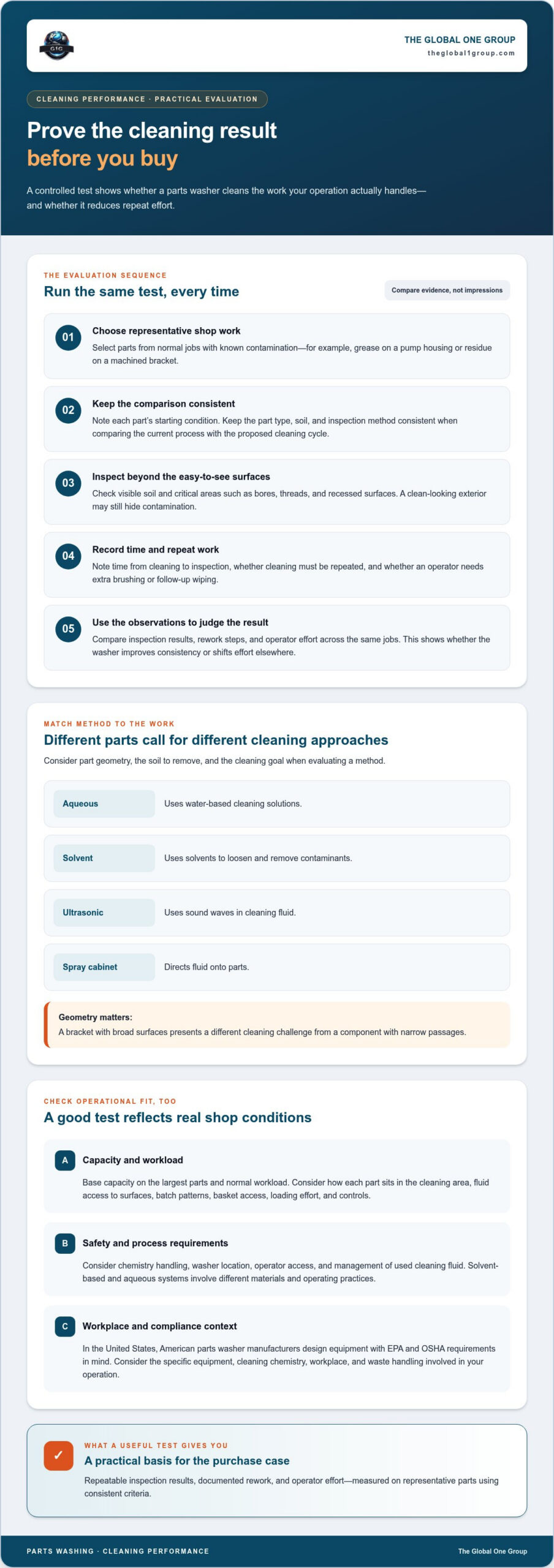
A parts washer merits consideration when it cleans the parts your operation actually handles. Compare results on a repeat job, such as removing grease from a pump housing or residue from a machined bracket. Record visible soil, time from cleaning to inspection, and repeat cleaning. Consistency matters because a clean-looking exterior may still hide contamination in bores, threads, or recessed surfaces.
Aqueous washers use water-based cleaning solutions, while solvent models use solvents to loosen and remove contaminants. Ultrasonic models use sound waves in cleaning fluid; spray cabinets direct fluid onto parts. Match the method to part geometry, soil, and cleaning goals. A bracket with broad surfaces presents a different challenge from a component with narrow passages.
Use a controlled comparison before deciding. Select representative parts from normal work, note their starting condition, and run them through your current process. Then assess the results against consistent inspection criteria. For example, check whether grease remains inside a threaded hole or an operator needs to brush the same surface again. Keep the part type, soil, and inspection method consistent.
In the United States, American parts washer manufacturers design equipment with EPA and OSHA requirements in mind. The considerations for a particular operation depend on its equipment, cleaning chemistry, workplace, and waste handling. Treat those factors as part of the selection process, rather than assuming every cleaning method creates the same operating conditions.
Choose washer capacity based on your largest parts and normal workload. Measure each workpiece and consider how it sits in the cleaning area, including space for fluid to reach surfaces that need cleaning. Then assess the batch pattern: an occasional large housing differs from small components arriving throughout each shift. Basket access, loading effort, and simple controls also affect daily use.
Review safety, fire, and environmental risks alongside cleaning results. Consider the chemistry’s handling requirements, washer location, operator access, and how the process manages used cleaning fluid. Solvent-based and aqueous systems involve different materials and operating practices. Choose a process that accounts for those differences, the work area, and operators’ routine tasks.
Build a repeatable acceptance test around actual shop work. Choose parts with known contamination, run the proposed cleaning cycle, and inspect critical areas using the same method each time. Note whether the operator needs extra brushing, another cycle, or follow-up wiping. These observations show whether the washer improves cleaning consistency or simply shifts effort to another step.
Cleaning performance supports the purchase case when the selected method reliably handles representative parts and fits the shop’s workload. Compare inspection results, rework steps, and operator effort across the same jobs. This evidence gives decision-makers a practical basis for weighing cleaning quality against equipment and process requirements.
2. Durability and construction quality
A parts washer works in a demanding environment. Cleaning fluid, repeated loading, and daily operation all test its construction. Assess the machine as a working asset, not just a cabinet with a pump. Look at the tank, access points, lid or door, and areas operators touch during routine use. These details shape maintenance effort and how smoothly the machine fits shop-floor routines.
With proper maintenance, many companies operate American-made parts washers for decades. That operating life depends on care, so include maintenance access in your assessment. Check whether operators can reach the areas that need routine cleaning and inspection. A hard-to-access filter or tank can turn a simple task into a disruptive one. Consider who will perform each task and whether the machine’s layout supports that work.
Inspect a candidate washer against your actual workload. A shop processing heavy components needs a different loading experience from one cleaning small parts in frequent batches. Consider how parts enter and leave the machine, where operators place baskets, and whether the work area allows safe access. Awkward handling can create daily friction even when the cleaning process suits the parts.
Use a consistent inspection sequence when comparing construction quality:
- Examine seams, edges, and access panels for fit and visible damage.
- Check that doors, lids, and handles move smoothly through their intended range.
- Review the tank and surrounding surfaces for signs of corrosion or fluid leakage.
- Identify routine service points and note whether staff can reach them easily.
- Assess how the washer sits in the work area and how operators load parts.
These checks turn a general impression into observations procurement teams can discuss. Record whether a door closes smoothly, a basket moves without obstruction, and maintenance staff can reach service areas. Compare candidate machines using the same workload and shop layout.
Construction quality also affects maintenance. Accessible components make inspection and upkeep easier to incorporate into established routines. Poor access can delay routine work or encourage operators to skip steps. Document required tasks, who is responsible for them, and how they fit alongside other equipment maintenance.
For a practical review of parts washer construction and upkeep, consider how the machine’s design fits your operating demands. Durable construction supports a stronger purchase case when it aligns with real loading conditions and maintainable routines. Compare structural details and service access before weighing long-term return.
3. Long-term return on investment
A parts washer’s return comes from measurable operating changes, not assumed savings. To understand how to justify purchasing a parts washer, use downtime, quality, and productivity records from the same types of jobs. Compare your current cleaning process with the proposed one, and separate observed results from estimates.
Start with a baseline. For a representative maintenance job, record how long parts wait for cleaning, how much staff time cleaning takes, and whether equipment waits for parts to return. Include repeat cleaning, inspection delays, and rework linked to cleanliness. A pump repair, for example, may involve several components, each with different cleaning and inspection needs.
Next, estimate how the washer could change those measures. Use a controlled trial or a documented process estimate for the same part types. Track cycle time, operator attention, and follow-up work separately. A shorter machine cycle creates value only if it reduces hands-on labor, clears a bottleneck, or returns usable parts to maintenance sooner.
Include quality data in the calculation. Log repeat cleaning, rejected parts, and inspection findings before and after the process change. If a bearing housing needs another cleaning pass, record the labor and delay. Don’t claim savings from improved quality unless your records connect it to reduced rework, fewer delays, or another measurable operational result.
Translate the evidence into an investment model. Compare purchase and operating costs with recurring gains from labor capacity, reduced rework, and less production disruption. Include cleaning chemistry, maintenance, and downtime in operating costs. Keep each assumption visible, so finance and operations can assess how to justify purchasing a parts washer using the same inputs.
A simple payback calculation divides the investment by the recurring net benefit over the same period. Use consistent accounting periods and include only benefits your records support. If labor hours shift to other essential tasks, describe the gain as added capacity. Don’t count it as payroll savings unless staffing costs actually fall.
Present baseline data, expected process changes, and the assumptions behind each projected benefit. A concise summary might show maintenance-job delays, cleaning labor, repeat-cleaning records, and operating requirements. Label trial results separately from projections, then show how each affects the decision.
Finally, test the model against a less favorable scenario. Recalculate the case with smaller labor gains or more frequent maintenance. If the purchase still supports operational priorities, decision-makers can see what drives the return and how to justify purchasing a parts washer without relying on one optimistic projection.
4. Total cost of ownership
Detergent, solvent, and waste-disposal costs depend on chemistry selection, cleaning volume, fluid life, and the waste stream. Include replenishment, safe handling, storage, and disposal in the operating estimate, as each can change the cost of running a washer.
Start with a cost inventory covering the full operating cycle. Record the washer’s purchase cost separately from recurring expenses, then include installation needs, utilities, cleaning chemistry, routine maintenance, replacement components, operator time, and waste handling. A low purchase cost, for example, can conceal frequent fluid changes or maintenance that raises ongoing expenses.
Give cleaning chemistry its own line in the estimate. A detergent or solvent’s suitability depends on the soils, materials, and cleaning process. Track how much the operation consumes, how often staff replace or refresh it, and what condition triggers a change. Compare records across representative jobs rather than assuming every part uses the same amount.
Waste handling also belongs in the calculation. Identify the waste generated by the cleaning process, how staff collect it, and the handling and disposal steps required. A shop cleaning greasy components, for example, should account for used fluid and residues removed during maintenance. Keep these activities visible in the operating budget.
Maintenance costs affect both spending and availability. List routine inspection and service tasks, then identify the parts and labor each requires. For a filter replacement, include the component, staff time, and any interruption while the washer returns to operation. Apply the same logic to fluid changes and other planned upkeep.
Replacement risk matters too. A lower-cost parts washer may need replacement sooner, adding another purchase and potential disruption. Compare that possibility with each option’s expected maintenance demands. Use documented operating experience where available, and don’t treat purchase price as a complete measure of value.
For a practical comparison, place candidate machines in one worksheet and use consistent categories:
- Initial purchase and installation requirements
- Cleaning chemistry, replenishment, and fluid changes
- Routine maintenance, parts, and staff time
- Utilities and any production interruption during service
- Waste collection, handling, and disposal
- Replacement planning and the effect of equipment downtime
Keep assumptions visible. If fluid life depends on soil load or job volume, record those conditions beside the estimate. Separate measured expenses from projections, then test how the comparison changes if chemistry use, maintenance frequency, or replacement timing differs. This gives procurement and operations a clear basis for evaluating the washer’s total ownership burden.
5. How much labor time can a parts washer save compared with manual cleaning?
There’s no reliable labor-savings figure without timing your own cleaning jobs. Measure hands-on minutes for manual cleaning, then compare them with the operator time needed to load, unload, and maintain a washer. Keep machine cycle time separate from labor time. A cycle can run while an operator handles another task, but that creates usable capacity only when the workflow allows it.
Start with a representative job, such as cleaning a disassembled pump. Record each manual step: moving parts, applying cleaner, scrubbing, rinsing, drying, and checking results. Include setup and cleanup. Repeat the observation for the same part type and soil condition, then calculate average hands-on time from your records.
Next, run the job through the proposed washer process. Log loading, unloading, required inspections, and hands-on follow-up. Record unattended cycle time separately. If an operator must stay nearby or perform another task during the cycle, note that distinction. The comparison should reflect actual staffing and work-cell conditions, not assume that every machine minute becomes labor savings.
For each job, calculate the difference between manual hands-on time and washer-related hands-on time. Multiply that difference by the number of comparable jobs handled during the same planning period. Tie the job count to production or maintenance records. This gives you a defensible estimate of released labor capacity without inventing a universal time-saving claim.
Then determine how that capacity will be used. A technician who spends less time brushing components may return sooner to inspection, repair, or scheduled maintenance. That shift can reduce a backlog or keep another task moving. It doesn’t automatically reduce payroll. Present redeployed hours as capacity unless staffing costs actually change.
Include exceptions in the time study. A greasy gear housing may need different handling from a small bracket, while a recessed passage may still require inspection or follow-up. Record extra cleaning, transport, and delays for each example. Separate routine jobs from unusual parts so one difficult cleaning task doesn’t distort the estimate.
Use a simple log with fields for part type, manual steps, hands-on minutes, washer loading and unloading, follow-up work, and completed jobs. Have operators record the same steps during each comparison. Review the results with maintenance and production staff. Their observations can reveal bottlenecks, such as basket handling or waiting for parts to cool, that a stopwatch alone won’t explain.
Turn the measured difference into an operational decision: identify which work gains capacity, where staff will use it, and whether that change supports maintenance or production priorities. To assess suitable parts-washing options, connect the workload evidence to the cleaning process your shop needs.
The Global One Group: Parts washing, chemistries
The Global One Group supplies industrial parts washers, parts washing chemistries, and replacement parts for Magido and Fountain equipment. Turn to the Group when your evaluation points to a need for equipment suited to your workload, chemistry matched to the parts and soils you handle, or replacement components for those washer systems.
Use your job records to clarify the parts you clean, the soils involved, and the process requirements driving your decision. That context helps focus the discussion on practical cleaning needs rather than assumptions. If your assessment points to parts washing, chemistry, or Magido and Fountain parts, visit theglobal1group.com to contact The Global One Group.
Turn your evaluation into a clear decision
A strong purchase decision starts with shared ownership. Have operations, maintenance, and finance agree on the measures that matter before approval. That shared record keeps the decision grounded in shop priorities and gives the team a reference point for reviewing the investment after installation.
Use your findings to decide whether the current cleaning process serves the operation or creates avoidable friction. If you’re working out how to justify purchasing a parts washer, connect the evidence to a specific operational need and state the assumptions behind your decision. Clear reasoning helps decision-makers understand what the equipment is expected to support and how the team will assess its value.
The Global One Group can discuss your parts-washing requirements and related chemistries. Take the next step when your evaluation is ready: contact The Global One Group. A disciplined decision gives your team a practical path forward, built around the demands of your operation.
Frequently Asked Questions
What are the benefits of a parts washer for maintenance and repair operations?
A parts washer can help maintenance teams return components to inspection and repair with less manual handling. For example, a technician servicing a gearbox can clean removed components before assessing wear, rather than scrubbing each part at the workbench. A repeatable cleaning process can also make it easier to spot cracks, scoring, or blocked passages. The operational benefit depends on matching the washer and cleaning method to the parts and shop workflow.
How do you calculate ROI and payback period for purchasing a parts washer?
Calculate payback by dividing the investment by the net benefit over the same period. First estimate recurring benefits your records support, then subtract recurring operating expenses. Avoid counting the same improvement twice: labor capacity and reduced delay may overlap. If a technician uses released cleaning time on scheduled repairs, for example, count the capacity gain rather than also treating those hours as payroll savings.
What is the typical cost of a parts washer, including installation and operating expenses?
The price depends on the case and is given after a quote request. The full ownership estimate should account for the washer, installation needs, utilities, cleaning chemistry, routine maintenance, replacement components, operator time, and waste handling. Requirements such as part size, cleaning method, workload, and site setup shape the overall calculation. Compare the same cost categories across options so a lower purchase price doesn’t hide higher operating demands.
How do you estimate annual parts washer use, maintenance, and utility costs?
Build the estimate from operating records and planned tasks. Track cleaning cycles by part type, chemistry use, fluid changes, filter service, and other routine maintenance. For utilities, use the washer’s operating information and your facility’s usage data to estimate consumption across expected cycles. Separate one-time setup from recurring expenses, and revisit the estimate when workload or cleaning requirements change. This gives budgeting teams a practical annual operating picture.