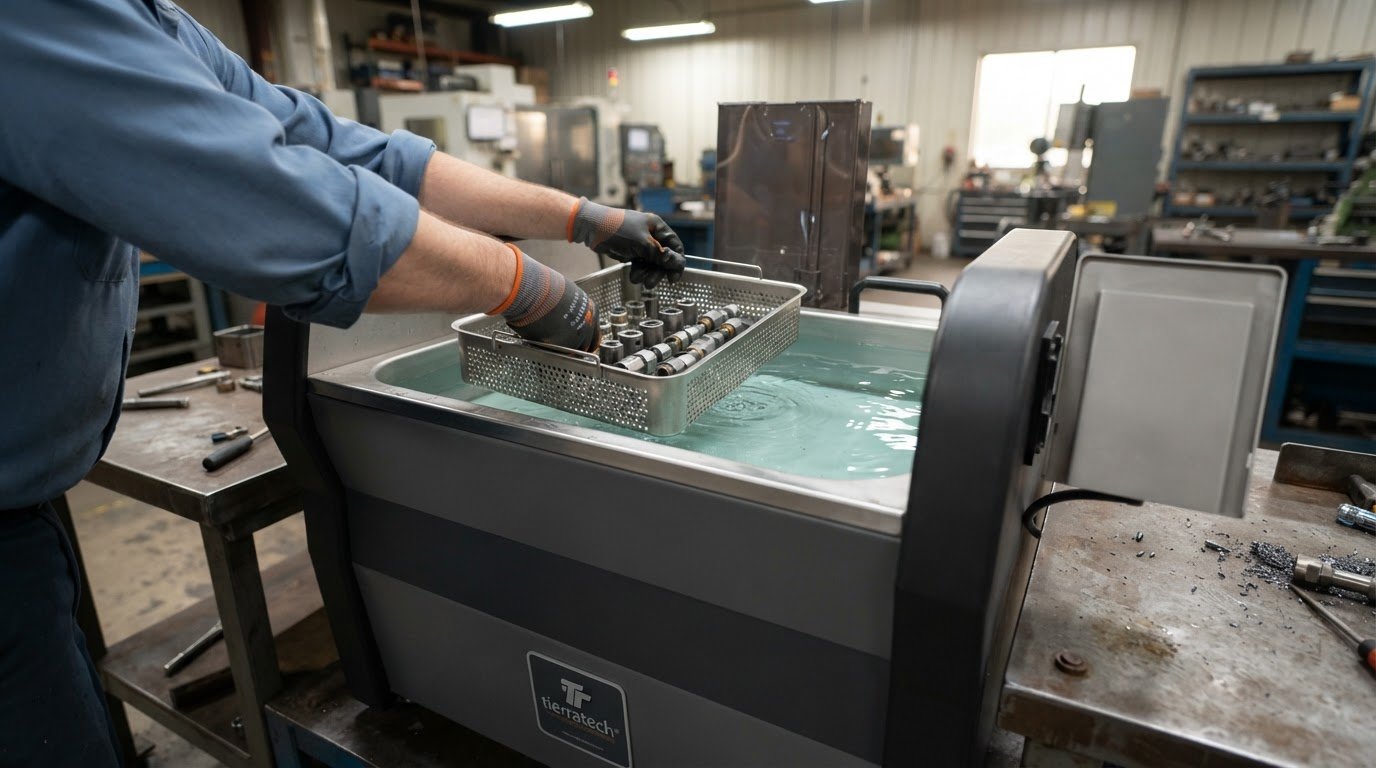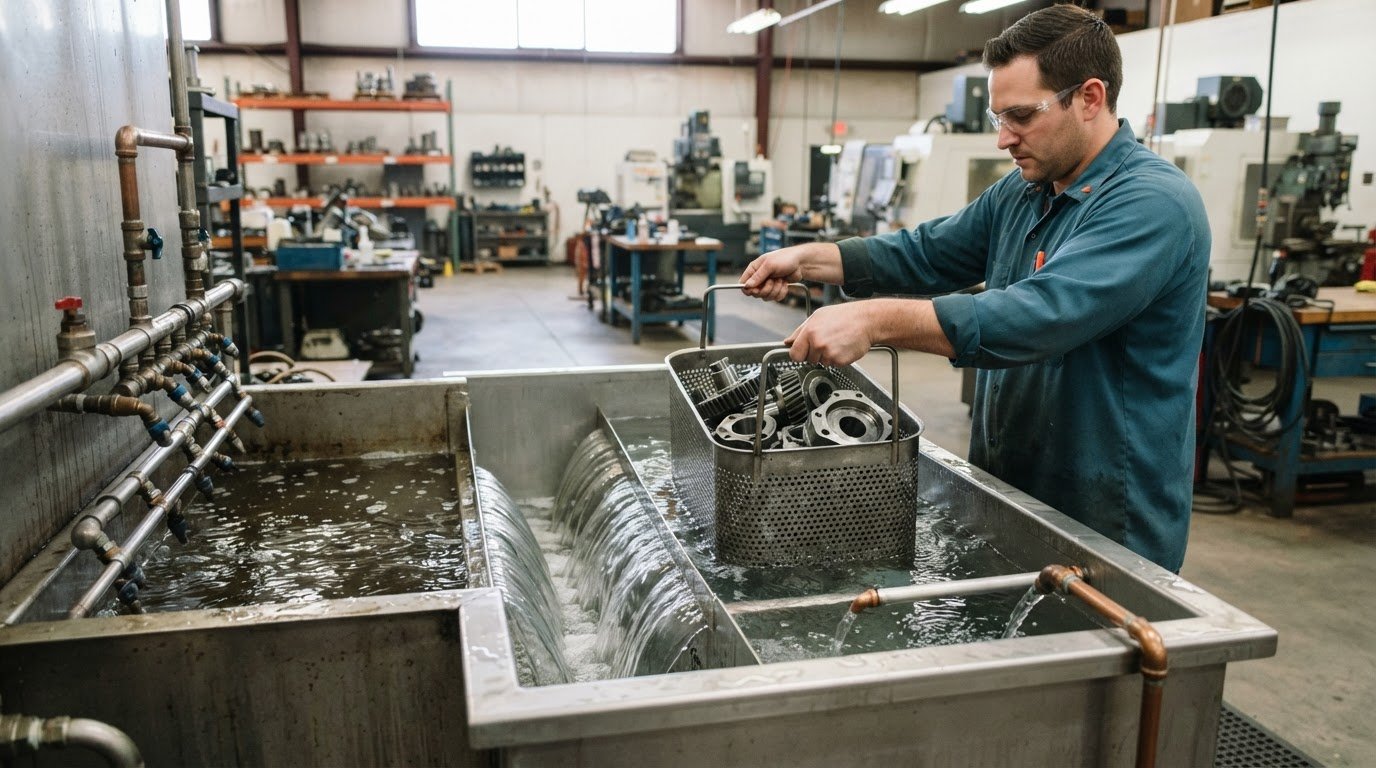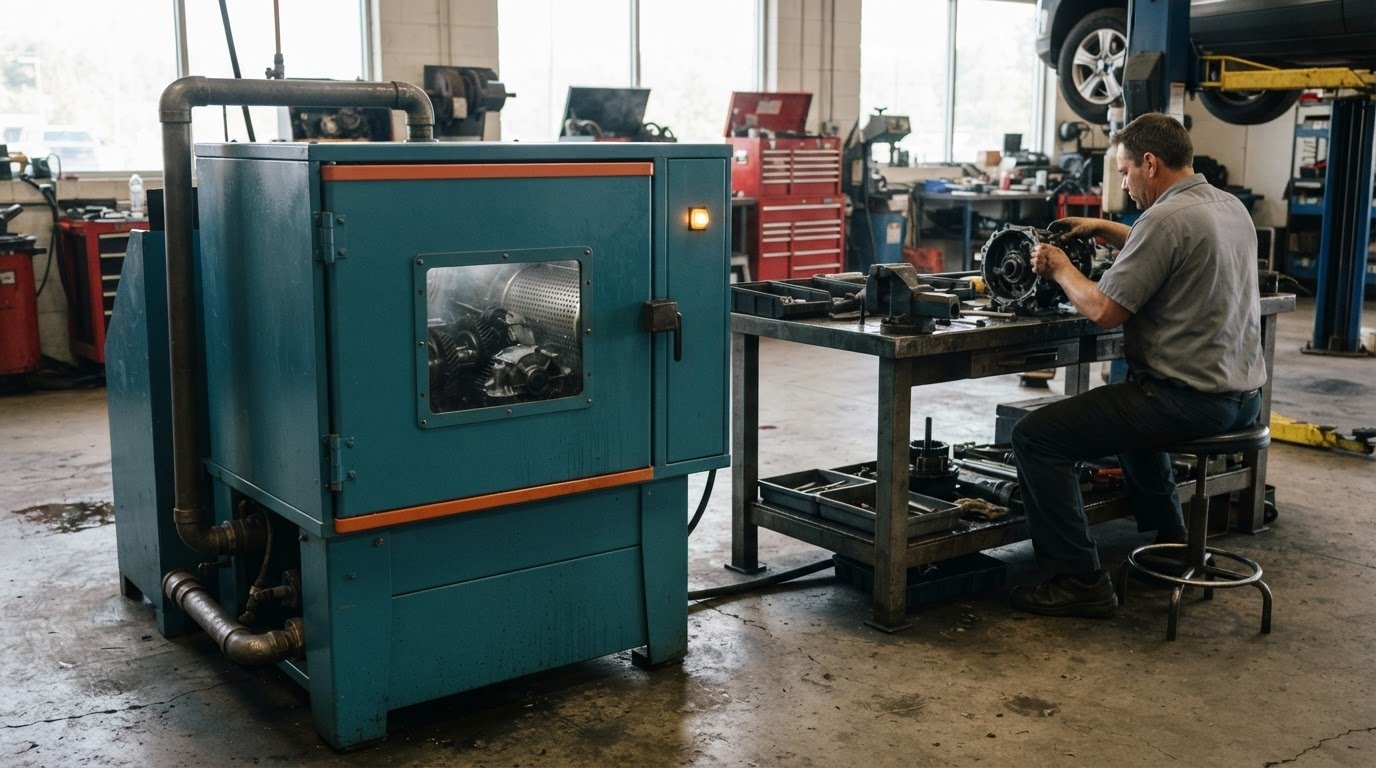
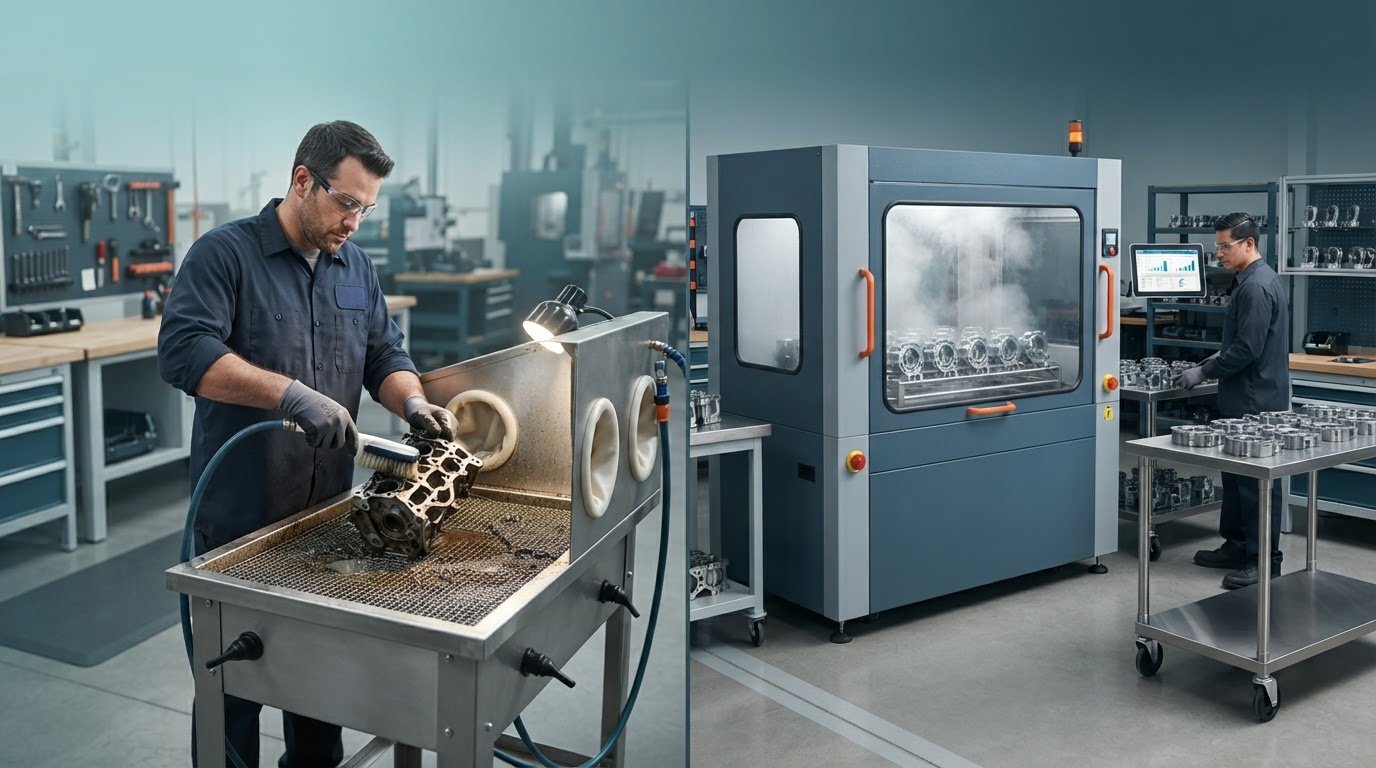
Manual washing usually costs less upfront, while automated systems require a larger equipment investment but may reduce labor costs over time. A useful manual vs automated parts washing cost analysis weighs labor against equipment, cleaning chemistry, utilities, maintenance, floor space, and the volume of parts moving through the shop.
That is the trade-off: manual cleaning gives operators direct control over individual parts but keeps them involved through much of the process. Automation can free technicians to handle other work while a cycle runs. The right choice depends on workload, cleaning requirements, and available space, not just the equipment’s purchase cost.
This comparison breaks down cost drivers for automotive, aerospace, and manufacturing operations, then explains how throughput and repeatable cleaning affect the decision. You’ll see which expenses to count, when manual cleaning remains practical, and when automation may better support your shop-floor demands.
Key Takeaways
- Count the labor tied up in cleaning, including time technicians could spend on maintenance or production work.
- Match the washer type to the parts’ geometry, contaminants, cleaning requirements, and available floor space.
- Compare detergent, water, energy, maintenance, and disposal needs across the full cleaning process, not just per wash.
- Manual cleaning can suit occasional jobs and parts that need hands-on attention; repeatable, high-volume work may benefit from automation.
- Use batch size and cleaning frequency to judge whether a washer can ease workflow bottlenecks and support the throughput your operation needs.
Cleaning requirements, shop space, and equipment selection
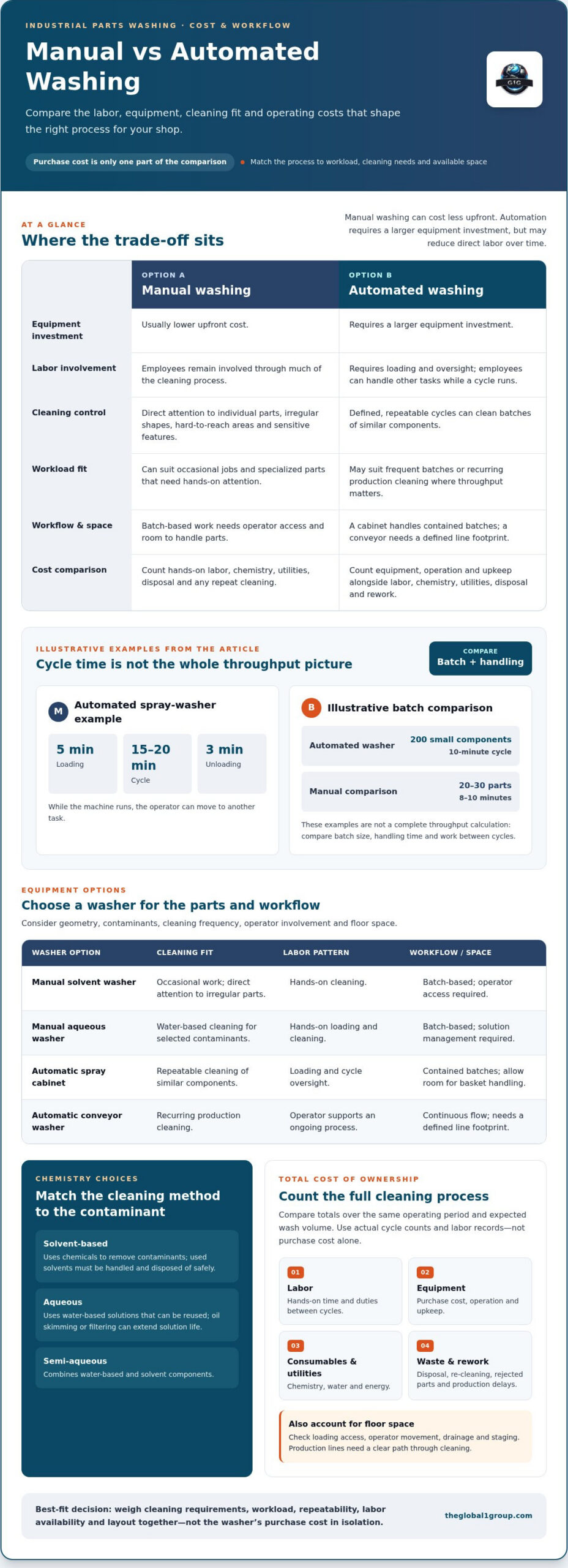
Start with the parts, contaminants, and cleaning frequency. A small maintenance shop cleaning occasional, irregular components may favor manual cleaning, which gives operators direct control over hard-to-reach areas and sensitive features. A facility processing dozens or hundreds of parts may benefit from automated equipment. Repeatable cycles can keep batches moving while technicians handle other work.
Next, match each part to its cleaning challenge. Grease, oil, and embedded debris may call for different methods. Solvent-based washers use chemicals to remove contaminants. Aqueous washers use water-based solutions that can be reused, while oil skimming or filtering can extend solution life. Semi-aqueous agents combine water-based and solvent components. Choose the chemistry and washer for the contaminant and required result, not simply the part’s size.
Include labor in the equipment comparison. Manual cleaning keeps an employee involved through much of the process. Automated equipment still requires loading and oversight, but employees can handle other tasks during a cycle. Compare hands-on minutes per batch, batches cleaned, and operator duties before judging total cost.
Then assess the equipment footprint and layout. A spray cabinet uses pressurized water and cleaning solution, often rotating parts in a basket. Immersion-agitation equipment submerges parts and agitates the solution. Cabinet, rotary drum, conveyor, and immersion systems suit different workflows. A conveyor moves parts continuously, while a cabinet processes contained batches. Check loading access, operator movement, drainage, and space for staging parts. A compact batch process may suit a tight maintenance bay; a production line needs a clear path through cleaning.
| Option | Cleaning fit | Labor pattern | Space and throughput |
|---|---|---|---|
| Manual solvent washer | Occasional work; direct attention to irregular parts | Hands-on cleaning | Batch-based; operator access required |
| Manual aqueous washer | Water-based cleaning for selected contaminants | Hands-on loading and cleaning | Batch-based; solution management required |
| Automatic spray cabinet | Repeatable cleaning of similar components | Loading and cycle oversight | Contained batches; allow room for basket handling |
| Automatic conveyor washer | Recurring production cleaning | Operator supports an ongoing process | Continuous flow; needs a defined line footprint |
Compare part geometry, contaminants, cleaning frequency, labor involvement, and available floor space. Occasional specialized cleaning may justify manual control, while frequent batches can make automated throughput a better operational fit.
Detergent, water, energy, and maintenance costs
Compare recurring expenses alongside labor and cleaning quality. Water and energy use, chemistry, maintenance, and rejected parts can all change the annual cost picture.
Petroleum- and chlorinated-solvent waste must be handled safely and disposed of in accordance with applicable federal and state regulations. A sound operating-cost comparison also accounts for how each process manages used chemicals and cleaning solution.
Annual Operating Costs
Manual washing can involve substantial labor and disposal costs. Automated washing adds equipment operation and upkeep, but can reduce direct labor when operators handle other duties during cycles.
Compare the figures with your own wash frequency and manual labor hours. Annual totals depend on cycle counts, work required between cycles, and whether cleaning delays production or maintenance tasks.
Chemical Use and Disposal
Manual solvent cleaning applies chemicals directly to parts, while aqueous machines use water-based cleaning solution. An automated washer’s solution can be reused, and oil skimming or filtering can extend its useful life. Track solution changes, chemical use, and waste handling for both processes, since disposal requirements and practices affect total operating cost.
Actual use depends on the machine’s cycle, heating needs, and operating pattern.
Rejected parts and repeat work add costs beyond the wash itself. Residual contaminants can lead to extra inspection, re-cleaning, or production delays, so include those consequences when comparing process consistency.
To calculate total cost of ownership, add annual labor, chemistry, water, energy, maintenance, disposal, and rework. Include equipment purchase cost, then compare totals over the same operating period and expected wash volume. Use actual cycle counts and labor records instead of comparing purchase costs alone.
For a practical review of machine and chemistry options, explore industrial parts-washing solutions as you assess the costs your process must control.
Automation’s role in reducing labor and increasing throughput
Automation changes how cleaning labor fits into production. An operator loads components, starts a defined cycle, then moves to another task while the machine runs. One automated spray-washer example allows five minutes for loading, a 15-20-minute cycle, and three minutes for unloading. Manual cleaning keeps employees engaged directly with parts, limiting their availability for other shop-floor work.
Cycle time alone doesn’t show total throughput. An illustrative automated washer processes a basket of 200 small machined components in a 10-minute cycle. A manual comparison handles batches of 20-30 parts in 8-10 minutes. Compare batch size, handling time, soil removal, and operator involvement. A fast cycle won’t clear a bottleneck if parts wait for loading, inspection, or downstream work.
For repeat production, automation can provide consistent cleaning cycles across similar components. A machining shop example cleaned a batch of 75 parts in a 12-minute automated cycle. Its manual solvent-wiping process took two operators about 45 minutes per batch of 50 parts. The comparison highlights both labor and batch capacity. Grease, part geometry, and loading arrangements still determine whether the process suits each component.
Labor savings depend on how crews use the time released. Automated systems can allow one operator to manage two or three machines simultaneously. Across operations, automated parts-washing systems can reduce labor requirements by 60 to 75%. Those gains matter most when staff can shift to maintenance, inspection, or production support instead of waiting beside a washer.
Throughput also depends on choosing a cleaning action suited to the soil. Spray pressure, heated water, specialized detergents, immersion, and agitation loosen contaminants in different ways. Aqueous cleaning solutions serve water-based processes; solvent cleaning uses chemicals to remove contaminants. Select a cycle for the component and residue, then assess whether its handling sequence fits the production line.
Automation can affect wider equipment performance, too. Automated parts-washing systems can improve Overall Equipment Effectiveness by 15 to 25%. That measure connects availability, operating speed, and acceptable output, so a cleaner parts flow can support more than washer utilization alone. Track labor hours, batches completed, repeat cleaning, and parts waiting before and after installation. These measures show whether automation improves the actual constraint, rather than simply shortening one wash cycle.
Parts washing in automotive, aerospace, and manufacturing
Industry affects the cost equation: contamination, part mix, cleaning frequency, and line pace all matter. Automotive, aerospace, and manufacturing operations processing recurring batches may benefit from automation; smaller shops cleaning occasionally may prefer manual control.
Automotive Parts Washing
Automotive shops clean engine and powertrain components with different geometries and contamination patterns. A mid-sized automotive components manufacturer reported a 12% rejection rate linked to residual particulates on powertrain components. After installing an automated conveyor tunnel washer, its rejection rate dropped to under 0.5% within six months. This example shows why buyers should assess cleaning effectiveness alongside labor and equipment costs.
A repair shop’s workload may be less uniform than a production line’s. Manual cleaning can suit occasional engine work or components needing focused attention. A shop running repeated batches can compare operator time, part flow, and cleaning consistency before selecting equipment. The key question is whether cleaning delays other work or leads to recurring rework.
Manufacturing Parts Washing
Manufacturers often process similar industrial parts repeatedly, making consistent cycles valuable. A machining shop example used manual solvent wiping with two operators for about 45 minutes per batch of 50 parts. Its automated process cleaned 75 parts in a 12-minute cycle. The comparison points to possible gains in labor allocation and batch throughput, but each operation must account for its own parts, contaminants, and cycle requirements.
Production volume helps determine equipment fit. Operations regularly processing dozens or hundreds of parts may benefit from automated washing. A conveyor supports continuous movement, while batch equipment suits work organized around baskets or groups of components. Match loading and unloading steps to the production sequence; otherwise, parts may simply queue elsewhere.
In aerospace settings, part geometry, contamination, and process repeatability deserve close attention. A mixed workload may include components requiring different cleaning approaches, so identify the soils and required results before choosing a process. Manual methods allow direct attention to specific areas; automated cycles can provide repeatable treatment for recurring components. Compare cleaning steps with the actual work mix rather than assuming one method suits every part.
Shop size matters less than cleaning frequency and workflow. A small facility with daily batches may have a stronger case for automation than a larger facility cleaning parts occasionally. Track batch counts, operator involvement, rejected parts, and delays over a representative production period. These measures show whether cleaning limits output or specialized manual work remains more practical.
Use the industry context to guide the decision: prioritize manual control for occasional or specialized cleaning, and evaluate automation for recurring volume, repeatability, or production-line constraints.
How do solvent, detergent, water, and disposal costs compare between manual and automated parts washing?
Consumable costs depend on chemistry, soil load, wash frequency, and waste handling. Compare both methods per batch or cycle, then project those figures across the operation’s annual workload. Track disposal and water use as separate line items, since they can shift the comparison beyond the detergent bill.
Manual solvent cleaning applies degreaser directly to parts, with chemical consumption shaped by wiping practices and contamination levels. Track how much solvent becomes waste, not just how much the shop purchases.
Automated detergent use depends on the selected machine cycle and solution-management routine. Treat these as distinct measures: cost per cycle helps assess each wash, while annual spending reflects actual operating volume.
Solution reuse can change the cost profile. Aqueous cleaning solution can be reused, and oil skimming or filtering can extend its useful life. Modern industrial washers can extend solution life by 10 to 15 times compared with manual processes. They can also reduce water consumption by 70 to 85% and chemical costs by 50 to 60%. Those reductions depend on process design and how the equipment manages the solution.
Use the same comparison method for both systems. Record the same operating period and count the same types of cleaning work. Separate recurring inputs from waste charges so an unusually large disposal event does not obscure routine use. Then compare cost per batch or cycle alongside cleaning results and labor requirements.
- For manual solvent cleaning, track degreaser consumed, contaminated waste generated, and disposal frequency.
- For automated washing, record detergent added, water used, and solution replacement or filtration intervals.
- For both methods, match disposal records to the solvent or cleaning solution that produced the waste.
- Compare equivalent batches and cleaning requirements, then calculate recurring costs across the same operating period.
Use those records to identify whether chemical consumption, water, or waste handling drives the gap. For a process review, assess your parts-washing chemistry needs against the contaminants and wash routine your operation handles.
The Global One Group: Industrial Parts Washers
The Global One Group helps operations match parts-washing equipment and chemistry to their cleaning needs. Turn to the team when manual labor, recurring batches, or changing contaminants prompt a review of your process. Its industrial parts washers support equipment selection, while its parts-washing chemistries address cleaning requirements. The Global One Group also supplies replacement parts for Magido and Fountain washers.
Before selecting equipment, define the parts, contaminants, cleaning frequency, operator involvement, and available floor space. These criteria connect your cost analysis to the shop-floor requirements that shape washer selection.
Contact The Global One Group to discuss your parts-washing equipment, chemistry, or Magido and Fountain replacement-parts needs.
Turn the Cost Review Into an Operating Decision
Make the next step a focused review of your cleaning workflow. Choose representative parts, document the cleaning process, and identify where labor, waiting time, or repeat work disrupts production. Then compare equipment options against that actual workload, including how they fit your floor plan and operating sequence.
A useful manual vs automated parts washing cost analysis should guide an actionable decision, not sit in a spreadsheet. Set clear priorities: freeing technician time, increasing batch flow, addressing difficult contamination, or keeping occasional cleaning flexible. Rank them before choosing equipment or adjusting chemistry. This keeps the purchase tied to operational needs rather than headline specifications alone.
The Global One Group offers industrial parts washers, parts-washing chemistries, and parts for Magido and Fountain washers. If you’re ready to discuss your process and next steps, contact The Global One Group. A clear picture of your shop’s cleaning demands is a strong starting point for a more effective operation.
Frequently Asked Questions
What’s the true cost of manual parts cleaning?
True cost includes operator time, diverted skilled labor, cleaning materials, waste handling, and repeat work. Include lost billable work when mechanics clean instead of repairing or producing. A useful manual vs automated parts washing cost analysis also counts delays and rejected parts, not just labor assigned to cleaning.
What’s the typical ROI timeline for an automated parts cleaning system?
Payback periods of 12-24 months are common for shops relying on one or more dedicated manual-cleaning operators. Calculate your own payback by comparing the system’s purchase and operating costs against labor time released, cleaning volume, and avoided rework. Use actual shift schedules and wash frequency. A system that sits idle or fails to address the shop’s main cleaning bottleneck won’t deliver the same return as one matched to recurring demand.
When Should Your Business Choose an Automatic Parts Washer?
Choose automated washing when recurring batches, high volume, or repeatable cleaning needs strain available labor. Operations processing dozens or hundreds of parts may benefit from a machine that lets employees handle other tasks during cleaning. For example, a production line handling similar components can build a defined wash cycle into its workflow. Compare loading and unloading duties, queue time, and downstream inspection needs before deciding whether automation will improve the full process.
When Is a Manual Parts Washer the Better Option?
A manual washer can suit occasional cleaning, low-volume shops, or parts requiring targeted attention. It gives operators direct control over irregular surfaces and areas needing extra work. Consider a repair bench handling varied components rather than steady batches: a manual process may suit that changing mix without adding automated equipment. Weigh the flexibility against the employee time each job requires and its effect on other shop-floor duties.
What does manual parts washing equipment cost compared with automated parts washers?
Manual equipment generally costs less to purchase initially, while automatic systems require a larger capital investment. The right comparison depends on configuration, cleaning method, parts, and workload. Separate equipment purchase from installation and recurring expenses, then compare options over the same ownership period. For an operation considering an industrial washer, final equipment cost depends on the project and is provided after a quote request.
How much do manual and automated parts washing systems cost to operate per year?
Annual operating costs depend on cleaning volume, labor assignment, chemistry, utilities, maintenance, and waste disposal. Build an annual comparison from payroll and purchasing records, and count automated cycles, supervision, utilities, and upkeep over the same period.
What are typical labor costs and labor hours for manual versus automated parts washing?
Manual cleaning ties an employee to the parts for much of the process, while automated washing shifts labor toward loading, unloading, and oversight. One example estimates over 1,900 labor hours a year when two employees clean parts four hours daily. Compare recorded hours with the automated tasks that remain, then account for whether freed employees can take on productive maintenance or shop work.
What are the maintenance and repair costs for manual and automated parts washers?
Maintenance costs vary with washer design, usage, cleaning chemistry, and the condition of filters, pumps, and other components. Manual setups may need less machine upkeep but still require cleaning supplies and waste management. Automated systems add service needs for mechanical and fluid-handling components. Track maintenance labor, replacement parts, downtime, and solution care separately to identify recurring costs and expenses caused by specific repairs.