A parts washer that won’t reach its operating temperature can compromise cleaning and slow production. A failed heating element is one possible cause, but it isn’t the only one. Parts washer heating element replacement should start with diagnosing the fault, not ordering a part and hoping it fits. A tripped breaker, wiring issue, or control problem can also interrupt heating.
To avoid extended downtime, first identify the likely cause, then match any replacement to the exact washer. This guide covers warning signs, ways to distinguish an element fault from other electrical problems, and the details to verify when selecting a part, including the washer model and the element’s electrical and physical specifications. It also explains how to plan the repair safely and verify operation before returning the washer to production. For model-specific ratings, dimensions, connections, and installation instructions, follow the equipment manual and part documentation.
Key Takeaways
- Slow, inconsistent, or absent heating signals a problem, but doesn’t prove the element has failed.
- Use a structured diagnostic process to narrow down the fault before ordering parts or beginning repairs.
- For parts washer heating element replacement, prioritize the exact washer model and manufacturer part number over visual similarity.
- Follow the washer manual and a qualified technician’s judgment for shutdown, power isolation, fluid handling, and installation.
- Before returning the washer to production, test connections, controls, and seals, and verify temperature against the manual. The Global One Group supplies replacement parts for Magido and Fountain equipment.
When Does a Parts Washer Heating Element Need Replacement?
A parts washer that heats slowly, holds temperature inconsistently, or fails to heat can disrupt cleaning cycles and production schedules. The element may be at fault, but symptoms alone can’t confirm the diagnosis. A weak electrical supply, faulty thermostat or control, damaged wiring, or fluid-level issue can produce similar behavior. Treat a temperature change as a fault to investigate, not proof that the element needs replacement.
Stop using the washer if you notice damaged electrical components, a burning smell, fluid leaking near electrical parts, or repeated breaker trips. Follow the machine’s shutdown and power-isolation instructions, and keep it out of production until the cause has been assessed. Continuing to operate equipment with these warning signs can put people and machinery at risk.
What symptoms can point to a failed heating element?
Persistent failure to reach the required operating temperature is a clear reason to investigate the heating system. A washer that takes longer than usual to heat or cycles unevenly also needs attention, but neither symptom identifies the element as the cause. A change in operating conditions, temperature control, or the machine’s power supply may explain the difference.
Compare actual operation with the washer manual and the temperature requirements of your cleaning process. Record what the washer does, when the problem occurs, and whether it happens in every cycle. A Parts washer can use different designs and components, so observations from one machine don’t establish a diagnosis for another. Clear symptom records give maintenance personnel a useful starting point and help avoid guesswork.
What else can cause a parts washer to stop heating?
Consider the full heating circuit, not just the element. A thermostat may fail to sense or regulate temperature correctly. Wiring or connections may be damaged, and an electrical supply problem can prevent the heater from receiving the power it needs. Depending on the washer’s design, a control component or fluid-level condition may also interrupt heating.
Replacing a working element won’t fix a fault elsewhere. For example, a breaker that trips repeatedly signals an electrical issue that needs investigation, not a reason to install a different-rated heater. Don’t assume that slow heating means the element has weakened, or that one visible symptom points to a specific component.
- Check the equipment record: Note the washer model, reported temperature, cycle conditions, and any warning indicators.
- Review the manual: Follow the manufacturer’s troubleshooting guidance and wiring or control documentation for that machine.
- Escalate electrical testing: Have a qualified technician assess the supply, wiring, controls, and element using appropriate equipment and the manufacturer’s procedures.
Good parts washer heating element replacement planning starts with an accurate diagnosis. Identify the failed component, then use the washer’s exact model and part documentation to guide the next step. This avoids unnecessary work and reduces the risk of ordering a part that doesn’t match the machine.
How to Diagnose a Parts Washer Heating Element Before Replacing It
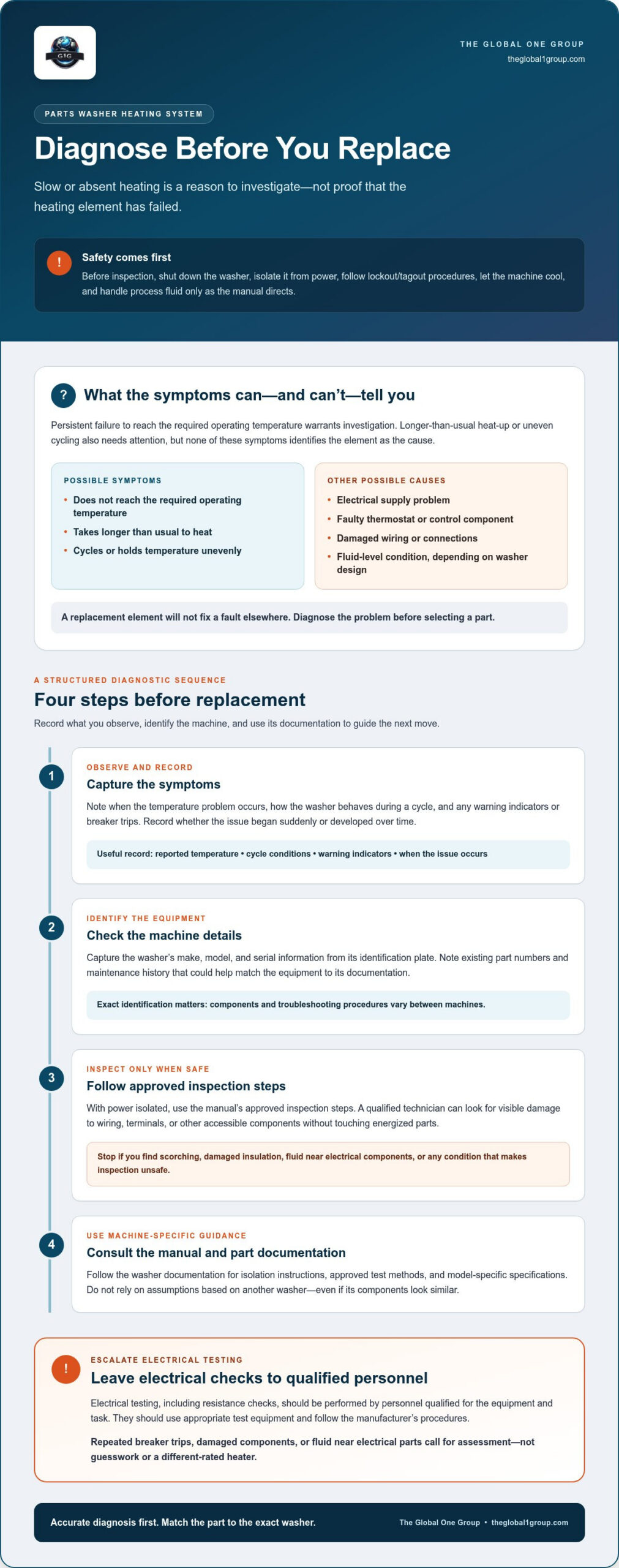
A reliable diagnosis helps prevent replacing a sound element while the actual fault remains in the supply, controls, thermostat, or connections. Follow a consistent sequence and document what you find. Before inspection, shut down the washer, isolate it from power, and follow the equipment’s lockout/tagout procedures. Let the machine cool, and handle process fluid only as the manual directs.
- Record the symptoms. Note when the temperature problem occurs, how the washer behaves during a cycle, and any warning indicators or breaker trips. Record whether the issue began suddenly or developed over time. These details help a technician distinguish an element fault from a control or supply problem.
- Identify the machine. Capture the washer’s make, model, and serial information from its identification plate. Record any existing part numbers or maintenance history that could help match the equipment to its documentation. Exact identification matters because components and troubleshooting procedures vary between machines.
- Inspect only when safe. With power isolated, follow the manual’s approved inspection steps. A qualified technician can look for visible damage to wiring, terminals, or other accessible components without touching energized parts. Stop if you find scorching, damaged insulation, fluid near electrical components, or any other condition that makes inspection unsafe.
- Consult the documentation. Use the washer manual and part documentation for isolation instructions, approved test methods, and model-specific specifications. Don’t rely on assumptions based on another washer, even if its components look similar.
What should you inspect before testing the element?
Start with information, not disassembly. Confirm the model details, write down the heating behavior, and review the manufacturer’s troubleshooting sequence. Check the manual for power-isolation and safe-access instructions before any inspection. If you see visible damage, leave the equipment isolated and have a qualified technician assess it. Never inspect or handle energized components.
When should a qualified technician perform electrical tests?
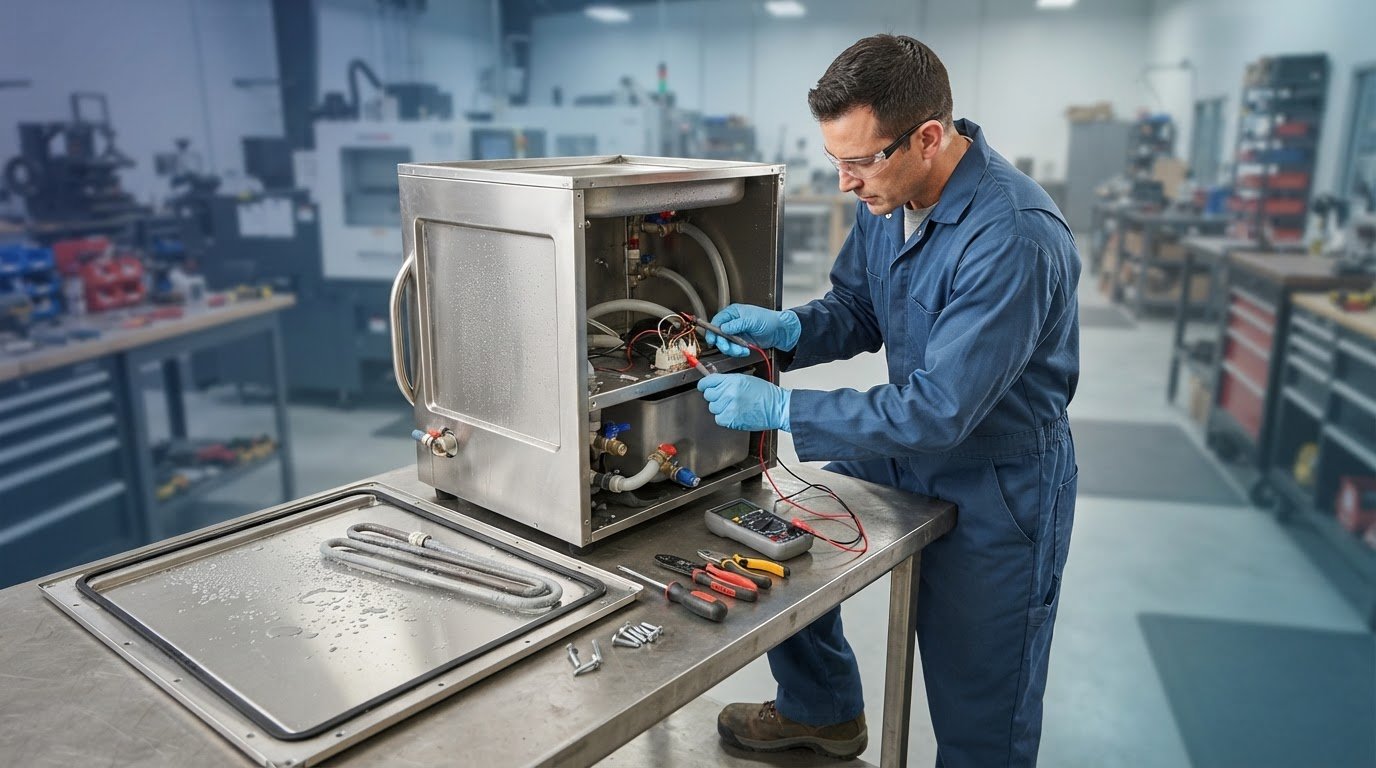
Electrical testing, including resistance checks, should be performed by personnel qualified for the equipment and task. The technician should use appropriate test equipment, follow the manual’s procedure, and compare results with the manufacturer’s expected readings. There’s no universal resistance value or pass/fail threshold for every parts washer element. The correct interpretation depends on the specific machine and component.
Testing should cover the relevant circuit, not just the element. Depending on the design and findings, a technician may need to assess the electrical supply, connections, thermostat, and control components to locate the fault. The goal is to establish whether the element has failed or another issue is interrupting heat. Don’t energize the washer to troubleshoot unless the manufacturer’s procedure and the technician’s training support that test. For process-specific hazards, OSHA’s guidance on parts washer safety provides related context on parts cleaners, dip tanks, and solvents.
Once the diagnosis points to a failed component, use the washer’s exact identification details to guide parts selection. The Global One Group supplies replacement parts for Magido and Fountain equipment. Magido and Fountain parts resources can help you keep brand-specific equipment identification in view as you plan the next step.
How to Choose a Compatible Parts Washer Heating Element
The right replacement must match the washer, its electrical system, and its cleaning process. A heater that looks similar or fits the opening can still be incompatible. For a reliable parts washer heating element replacement, start with the washer’s exact model and the manufacturer’s part number. Verify every specification against the manual and part documentation before ordering.
| Compatibility check | What to match | Why it matters |
|---|---|---|
| Washer identification | Exact make, model, and serial information | Element requirements can vary by machine and configuration. |
| Part identification | Manufacturer part number and any superseding number listed in documentation | A confirmed part reference is more reliable than appearance alone. |
| Electrical ratings | Voltage, phase, and power rating | These must align with the washer’s electrical design and documentation. |
| Physical fit | Element dimensions, mounting arrangement, and connection type | A part that fits physically may still connect incorrectly or be electrically unsuitable. |
| Process requirements | Specified operating temperature and fluid compatibility | The element must suit the washer and the process it supports. |
Which equipment details identify the right replacement?
Use the machine nameplate to capture its identity, then compare that information with the manual, parts documentation, and markings on the existing element. Treat the manufacturer part number as the strongest selection reference. If the number differs, use only a documented replacement or supersession rather than assuming a similar-looking part is equivalent.
Verify voltage, phase, power rating, dimensions, mounting, and connections against the documentation for that washer. Don’t infer compatibility from one matching detail. An element with the right shape may have the wrong electrical rating, while a correct rating alone doesn’t establish that its connections or mounting suit the machine.
How do washer design and cleaning chemistry affect selection?
Check the washer maker’s element requirements alongside the process temperature specified for your cleaning operation. Chemistry and soil load affect cleaning conditions and may influence the operating temperature your process needs, but they don’t make heating elements interchangeable. The washer’s approved component specifications remain the deciding factor.
Review the parts washing chemistries selection guide to understand how cleaner choice relates to the cleaning task. The EPA’s Schick Manufacturing case study describes a move from solvent cleaning to aqueous parts washing, offering context on how cleaning methods can change. It doesn’t establish heater compatibility. The washer’s own documentation does.
Before committing to a part, resolve any mismatch between the nameplate, existing element markings, and manual. For Magido and Fountain equipment, accurate identification also helps connect the washer to the correct brand-specific replacement parts.
How to Replace a Parts Washer Heating Element Safely
Heating element replacement is model-specific work. The washer manual and a qualified technician’s judgment govern each step, including isolation, fluid handling, removal, and installation. Don’t use a generic procedure for instructions that vary by machine. The outline below helps you plan the work and identify the checks required before the washer returns to production.
How should the washer be prepared for element replacement?
Start with a controlled shutdown. Isolate the washer from its power source and apply the site’s applicable lockout/tagout procedures before opening equipment. Allow the system to cool, then handle or drain cleaning solution only as the manufacturer’s instructions direct. Confirm the replacement part against the washer documentation, and gather the tools specified for that model before work begins.
Use this preparation sequence:
- Review the manual. Locate the model-specific shutdown, isolation, access, and fluid-handling instructions.
- Secure the equipment. Stop operation, isolate power, and apply applicable lockout/tagout procedures. Keep the machine out of service during the repair.
- Make the work area safe. Allow components and fluid to cool as directed. Follow the manual for draining, containing, or otherwise handling the cleaning solution.
- Confirm the part and tools. Compare the replacement with the washer’s part documentation and prepare only the tools the manufacturer specifies.
What should happen during removal and installation?
A qualified technician should follow the washer-specific sequence to access, disconnect, and remove the old element. Don’t guess at wiring positions, fastener torque, sealant, or gasket reuse. Those details depend on the equipment and replacement documentation. If the instructions don’t cover a condition found during disassembly, pause and resolve it before proceeding rather than improvising.
With the old element removed, inspect the opening, gasket or seal, terminals, and surrounding components for damage, wear, or contamination. A compromised sealing surface or damaged connection can undermine the repair even when the new element is correct. The technician should install and reconnect the replacement according to its documentation and the washer manual, then check grounding, connections, seals, and guards against those instructions.
- Stop if parts don’t match. If the replacement’s mounting, connections, or documented ratings differ from the washer requirements, don’t force the fit or adapt the connection.
- Keep protective components in place. Reinstall guards and covers as directed before any return-to-service checks.
- Document the work. Record the part identification, repair date, and any damage or irregularities found for future maintenance reference.
Safe parts washer heating element replacement doesn’t end when the new component is installed. Keep power isolated until the technician completes the required inspection, confirms that guards and connections meet the manual, and is ready for controlled testing. The next section covers those return-to-service checks. For brand-specific equipment parts, explore Magido and Fountain parts resources.
How to Test the Repair and Prevent Repeat Heating Failures
A successful parts washer heating element replacement still needs a controlled return-to-service check. Follow the washer manual’s restart procedure, and restore power only after the technician has completed the required installation and safety checks. Then observe the machine’s heating and controls against the manufacturer’s guidance. Don’t return the washer to production just because it powers on.
What should be checked before returning the washer to service?
Before restart, confirm that the element connections, grounding, seals, covers, and guards meet the washer’s instructions. Follow the prescribed sequence for restoring power. During the initial run, watch for leaks, abnormal noise, unexpected control behavior, or electrical faults. Compare temperature performance with the manual and the cleaning process requirements, rather than relying on touch or an assumed heat-up time.
If a fault appears, stop the test and keep the washer out of production until a qualified technician evaluates it. Don’t bypass a control or continue operating through a leak, breaker trip, or unusual electrical symptom.
Record the repair while the details are available. Include:
- The washer identification and replacement part details.
- The checks performed and the test results observed.
- Any temperature-control irregularities, leaks, or other concerns that need follow-up.
These records give maintenance staff a baseline for future troubleshooting and help identify whether the repair restored expected operation.
How can operators reduce repeat element failures?
A replacement element may fail again if an underlying operating condition remains unaddressed. Maintain the bath, filtration, fluid level, and cleaning chemistry within the washer manufacturer’s guidance. Review temperature settings and operating conditions against both the washer requirements and the chemistry specifications. If a failure repeats, don’t keep swapping elements. Have a qualified technician reassess the circuit and operating conditions.
Cleaning method also shapes process requirements. The aqueous parts washer guide can help frame how aqueous systems work and what to consider when selecting one. Keep chemistry and temperature decisions aligned with the equipment documentation, and investigate recurring changes in bath condition or cleaning results rather than changing heater components without a diagnosis.
Before the next production cycle, verify that the washer holds the required operating temperature and that its controls respond as expected under the manual’s instructions. If performance drifts, stop and document the conditions so maintenance can trace the cause. The Global One Group supplies replacement parts for Magido and Fountain equipment. For brand-specific parts resources, explore Magido and Fountain replacement parts.
Keep the Washer Ready for the Next Production Run
Use this repair as a prompt to strengthen your maintenance planning. Track heating performance over time and note recurring changes in cycle behavior, bath condition, or cleaning results. Those patterns can help your team spot developing issues earlier and plan corrective work before a temperature problem disrupts a production run.
A careful parts washer heating element replacement supports reliable operation, but long-term performance also depends on matching equipment, parts, and cleaning chemistry to the job. The Global One Group supplies industrial parts washers, specialized washing chemistries, and replacement parts for Magido and Fountain equipment.
Explore Magido and Fountain replacement parts and keep your equipment planning moving forward. Accurate records and the right parts resource can help your team approach the next maintenance decision with greater confidence.
Frequently Asked Questions
How long does a parts washer heating element typically last?
There’s no dependable universal lifespan for a parts washer heating element. Service life depends on the washer’s duty cycle, operating conditions, fluid maintenance, and whether the element suits the process. Track installation dates and maintenance observations in the equipment log. If a heater’s performance changes sooner than expected, investigate operating conditions and related components instead of assuming the element reached a standard end-of-life interval.
Can a parts washer operate safely if its heating element is not working?
It may operate without heat if the machine’s design permits it, but that doesn’t mean the process remains acceptable or the washer is safe under every condition. A cold cycle may fail to meet cleaning requirements, while an electrical fault associated with the heater could create a hazard. Follow the washer manual and site procedures, and stop operation if the machine trips breakers, shows damage, leaks, or smells like burning.
What information do I need to identify the correct replacement heating element?
Gather the washer make, full model designation, serial information, and the element’s manufacturer part number or markings. Also collect the manual or parts documentation that specifies electrical ratings, dimensions, mounting, and connections. For parts washer heating element replacement, these records matter more than a photo or visual resemblance. A maintenance log or previous parts invoice can help resolve differences between an original number and a documented superseding part number.
Can a parts washer heating element be repaired instead of replaced?
That depends on the washer manufacturer’s service instructions and the type of damage. A technician should determine whether the element is a serviceable assembly or whether the fault lies in a replaceable connection or another circuit component. Don’t splice, reshape, or modify an element unless the manufacturer explicitly specifies that repair. Unapproved changes can affect electrical performance, sealing, and safe operation, and may leave the original fault unresolved.
Why might a replacement heating element fail again soon after installation?
A repeat failure can indicate an unresolved cause, such as incorrect electrical conditions, a control fault, damaged connections, or operation outside the washer’s specified conditions. Review the repair record alongside cycle and maintenance logs. Note whether the failure follows a particular operating pattern or bath condition. Have a qualified technician investigate the complete heating circuit and operating setup before installing another element, so the same fault doesn’t simply recur.
Does parts washer cleaning solution affect heating element performance?
It can affect the washer’s operating conditions. A cleaning solution that doesn’t match the equipment or process guidance may contribute to deposits, residue, or other bath conditions that interfere with normal operation. Follow both the washer maker’s fluid requirements and the chemistry supplier’s use instructions. Keep records of chemistry changes and bath maintenance. A performance shift after a product change deserves investigation, but doesn’t by itself prove the element has failed.
Should a parts washer be drained before replacing its heating element?
Not always. Whether draining is necessary depends on the washer’s design, element location, and the manufacturer’s service procedure. Some work may require fluid removal or a specific fluid level, while other configurations may have different instructions. Don’t drain, transfer, or dispose of cleaning solution based on a generic rule. Follow the manual’s procedure and appropriate fluid-handling practices, and ensure the equipment has cooled before work begins.