The lowest-priced washer can have the higher ownership cost. To compare the total cost of ownership for a parts washer, look beyond its purchase price to setup, energy, maintenance, repairs, training, and expected service life. Then weigh those costs against the work the machine can handle over its operating life.
A purchase price is easy to compare. The challenge is accounting for costs that accumulate during daily operation and the disruption a repair can cause. A useful comparison brings these factors together, so you can assess equipment against the same workload and time horizon.
This article explains what to include in a parts washer ownership estimate, how to use a calculator without treating its result as a final answer, and how cycle life affects cost per wash. You’ll also see how installation, energy use, preventive maintenance, and repairs shape the full picture, helping you make a practical equipment decision.
Key Takeaways
- Compare setup, energy, training, maintenance, and repairs alongside the purchase price to see the full cost over the washer’s working life.
- Build maintenance and repair expectations around the machine’s workload and service needs, since neglected upkeep can add downtime as well as repair costs.
- Use expected cycle life to compare the cost of each completed wash, rather than judging equipment by its initial price alone.
- Include direct and indirect expenses in your ownership estimate, then subtract projected resale value when relevant.
- Treat calculator results as estimates: align the inputs with your actual operating conditions before using them to compare options.
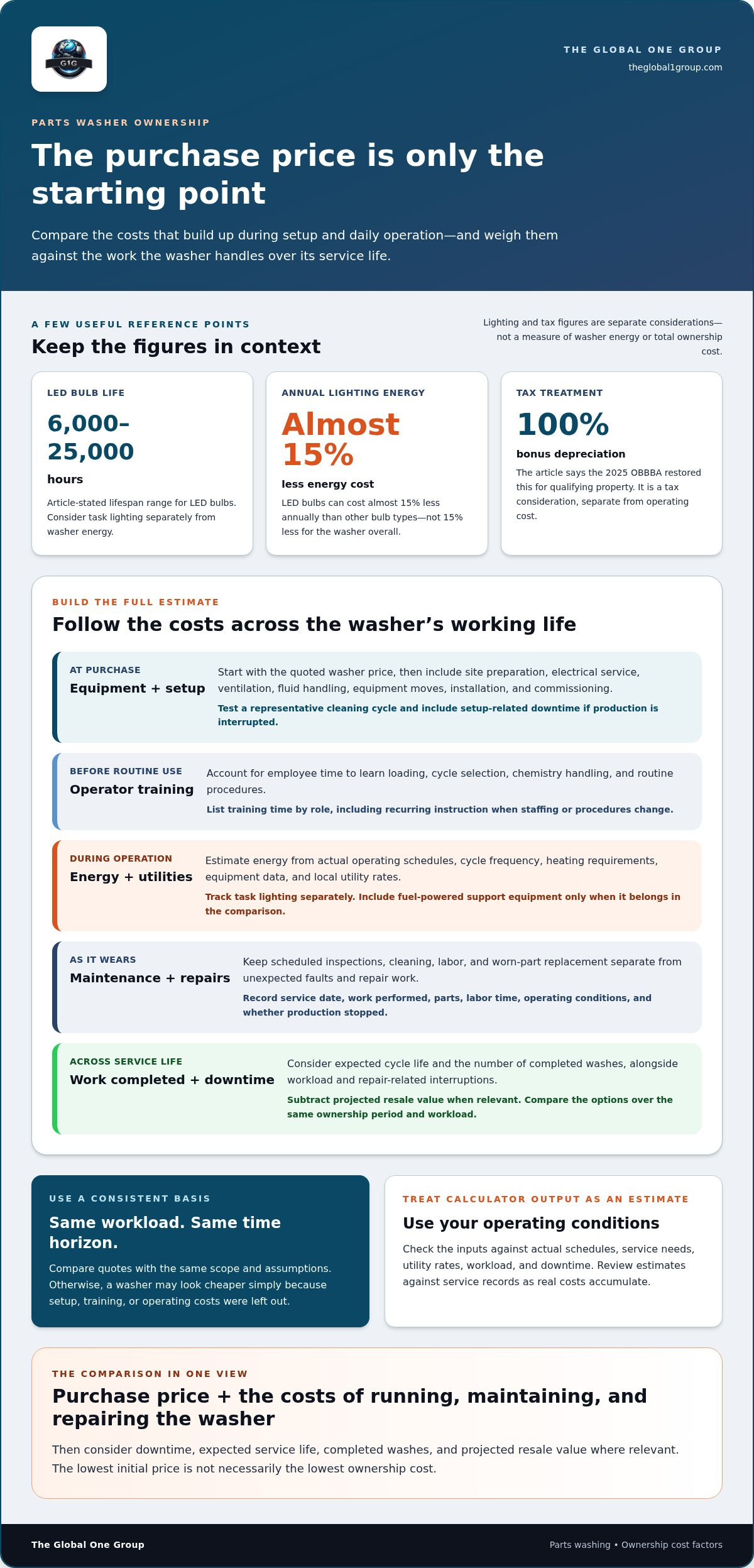
Installation, testing, training, and energy costs
A parts washer’s purchase price covers only the equipment itself. A useful estimate also accounts for installation, commissioning, operator training, energy, and setup-related downtime. Separate these from ongoing operating expenses, then compare options over the same ownership period and workload.
Plan for the washer’s location and connections when estimating installation costs. Include site preparation, electrical service, ventilation, fluid handling, and any equipment moves. During commissioning, run a representative cleaning cycle and confirm that the machine, chemistry, and parts-handling process work together. Record the time needed to install, test, and bring the washer into routine service. If setup interrupts production, account for that downtime as an operational impact.
Training also affects operating costs. Account for the time employees need to learn how to load parts, select cycles, handle chemistry, and follow routine procedures. A clear handoff helps operators work consistently and identify issues early. For a practical estimate, list training time by role, including any recurring instruction needed when staffing or procedures change. Compare washers using the same assumptions, or one option may seem cheaper simply because its training or setup costs were omitted.
Energy use depends on the washer’s operating demands, cycle frequency, heating requirements, and local utility rates. Use actual operating schedules and equipment data to estimate consumption, rather than relying on a broad category average. Include lighting separately where task lights affect energy use. LED bulbs can last from 6,000 to 25,000 hours and can cost almost 15% less in annual energy than other bulb types. Treat those figures as lighting comparisons, not as a measure of the washer’s total energy consumption.
Fuel efficiency matters only when fuel-powered equipment supports the washing process, such as a vehicle moving parts between work areas. Track that equipment separately from the washer. To calculate heavy-equipment cost per hour, divide fuel, maintenance, repair, insurance, and depreciation costs by the hours the equipment is used. Include these costs in a parts-washing estimate only when that equipment belongs in the comparison. This keeps the washer’s operating profile distinct from broader facility or material-handling expenses.
Tax treatment can affect the purchase decision, but it does not reduce the machine’s energy or maintenance demands. According to the Internal Revenue Service, the 2025 OBBBA restored 100% bonus depreciation for qualifying property. Businesses should distinguish this tax consideration from the washer’s full operating cost and assess how it applies to their circumstances. The purchase price and operating costs still need separate entries in the estimate.
A washer’s price depends on its configuration, installation requirements, operating demands, and included equipment. Compare quotes with the same scope, then add training, energy, and downtime assumptions to estimate total ownership cost.
Maintenance and repairs
Maintenance and repair expenses depend on workload, service intervals, parts, and repair-related downtime. Separate planned upkeep from unexpected failures to compare operating costs clearly.
Preventive Maintenance
Preventive maintenance means inspecting and servicing equipment on a schedule, before wear leads to failure. For a parts washer, track cleaning, inspections, fluid condition, and component wear in a dated service log. Regular inspections, cleaning, and preventive routines help extend equipment life and reduce unexpected repairs and downtime. Link each service entry to the operating conditions and issues observed.
Use the log to identify recurring patterns. For example, if a filter repeatedly needs attention after heavy soil loads, record the load conditions and service response. This helps distinguish routine upkeep from a developing fault and gives procurement and maintenance teams real operating history to use when estimating service needs for replacement equipment.
Maintenance and Repair Expenses
Maintenance expenses cover planned labor, inspection, cleaning, and replacement of worn components. Repair expenses cover faults that interrupt normal operation. Keep these categories separate. For each service entry, record the work performed, parts used, labor time, and whether the washer stopped production. These details reveal how upkeep affects direct expenses and the less visible cost of downtime.
Preventive maintenance can reduce total ownership cost by helping avoid costly repairs and extend equipment life. Compare planned work with actual repair records rather than assuming a new washer will need no attention. If a repair delays cleaning, record the operational impact, such as parts waiting for a wash cycle or staff switching to another task.
Maintenance and Repair Budgeting
A maintenance budget estimates the resources needed for scheduled service and likely repairs. Base it on the washer’s workload, service history, operating environment, and component complexity. Keep repair reserves separate from scheduled maintenance so an unexpected failure doesn’t distort the routine service plan.
Review the estimate against actual expenses as service records accumulate. If the washer runs more demanding cycles than expected, adjust labor and component assumptions. Separate washer service from facility energy costs: a higher utility bill does not by itself indicate a maintenance problem. This distinction helps teams identify what is driving cost changes and protect the equipment’s expected service life.
For a practical review, organize records by service date and category: planned inspections, cleaning, replacement parts, repairs, and downtime. Compare those entries with operating patterns, then revise the budget when recurring work emerges. If cleaning performance changes, review the maintenance log alongside the chemistry choices used in parts washing to assess whether process conditions may be contributing.
Cycle-life-based cost comparisons
Rated cycle life helps compare equipment beyond its purchase price. Combine it with workload, maintenance, downtime, and resale value to estimate the cost of each completed wash.
Comparing Equipment and Alternatives Using TCO
A total cost comparison combines purchase, operating, maintenance, repair, and end-of-life assumptions for each option. Depreciation and resale value can change which option costs less over the same service period. For a parts washer, estimate cost per cycle by adding ownership expenses, subtracting projected resale value, and dividing by usable cycles. Apply the same workload and time horizon to every option.
Cycle life makes the comparison tangible. One example assigns a budget commercial washer a rated life of 5,000 cycles and a premium washer 15,000 cycles. Those ratings alone don’t establish the better value. Compare each machine’s usable cycles with expected demand, repair history, downtime, and warranty coverage. A warranty can affect repair exposure, but it doesn’t replace the cost of planned maintenance or production disruption.
Aqueous and Solvent Washer Cost Comparisons
Aqueous and solvent washers use different cleaning approaches, so compare their complete operating requirements, not just their purchase prices. Include chemistry consumption, energy, labor, maintenance, equipment life, and waste handling in each estimate. The right fit depends on the parts, soil, cleaning process, and operating pattern, which all affect cycle time and resource use.
Use the same parts and cleaning target when comparing options. Track the chemistry and operator time each process consumes, then include disposal and downtime assumptions. Don’t treat cycles as equivalent unless they deliver the required cleaning result. This approach shows how process fit affects cost per accepted part, not just cost per machine cycle.
Waste Disposal Costs and Regulations
Parts washer waste disposal costs depend on waste characteristics, volume, handling needs, treatment, and pickup frequency. In the United States, applicable requirements depend on the waste stream and jurisdiction, including relevant federal, state, and local rules. Identify the waste generated by each process and include handling and disposal costs in the comparison.
For example, track spent cleaning fluid separately from filters and collected solids. Record the volume generated, how often it leaves the facility, and any preparation required before disposal. These details make disposal assumptions comparable across aqueous and solvent systems and prevent the estimate from omitting an operating expense tied directly to the selected cleaning process.
Capacity, Usage, and Cost per Part
Capacity affects how many parts fit in each load, while usage determines how often the washer runs. Together, they affect cost per part through cycle frequency, labor, energy, and chemistry consumption. Compare machines using actual batch sizes and cleaning volumes, not rated capacity alone.
For example, a washer sized for a large batch may run partially loaded when daily demand is low. A smaller washer may need more cycles as part volume rises. Estimate lifetime operating expenses, then divide by the number of parts cleaned to compare cost per part. Use consistent assumptions for load size, rejected parts, and maintenance across options.
Total cost of ownership definition
A total cost of ownership analysis for a parts washer measures its purchase price and ongoing expenses over its useful life. It gives procurement and maintenance teams a fuller comparison than the initial cost alone.
Include direct expenses such as installation, energy, chemistry, labor, maintenance, and repairs. Add indirect costs that affect production, including training time, downtime, and process changes. For example, a washer that interrupts a production line during repairs has an operational impact beyond the repair itself. Use the same operating period and workload when comparing equipment.
Separate acquisition from operation in your records. Businesses typically record asset purchases as capital expenditures, while operating and maintenance costs count as operating expenditures. This distinction helps finance teams track purchases separately from recurring expenses. It doesn’t change total cost, but clarifies where each expense belongs in budgets and reporting.
Organize a practical ownership estimate around these cost groups:
- Acquisition: purchase price and financing costs, including interest when applicable.
- Setup: installation, testing, and transition into routine use.
- Operation: energy, chemistry, labor, and other recurring inputs.
- Upkeep: scheduled maintenance, repairs, and replacement components.
- End of life: removal costs and projected resale value, where relevant.
Calculate net ownership cost by adding acquisition, setup, operation, and upkeep expenses, then subtracting projected resale value. If the washer cleans several types of parts, estimate the workload and resource use for each process. This is more useful than a single annual total, especially when one part family requires more frequent cycles or greater chemistry use.
Financing affects the timing and composition of cash outflows. If a purchase is financed, account for interest alongside the equipment cost rather than treating monthly payments as the asset’s full cost. Keep financing assumptions consistent across options. A cash purchase and a financed purchase can have different cash-flow patterns, even when the washer and operating requirements are the same.
Use the estimate as a decision model, not just a spreadsheet total. Document assumptions about operating hours, service intervals, expected life, and resale value, then update them as actual records accumulate. If actual cycle frequency differs from the estimate, for example, revise energy, chemistry, and maintenance assumptions together. Consistent inputs make equipment comparisons more meaningful and show which cost drivers deserve attention.
Using total cost of ownership calculators
A calculator can turn equipment assumptions into a comparable ownership estimate. A total cost of ownership calculator for a parts washer is useful only when its inputs reflect your workload, service needs, and replacement plan. Online heavy-equipment calculators can provide quick estimates, but accuracy varies. Treat the result as a model to review, not a final purchasing decision.
Start by defining the comparison period and the machine’s expected operating pattern. Enter the purchase price, installation and training costs, energy use, chemistry, labor, maintenance, repairs, and projected resale value. Include downtime where it affects production, and apply the same assumptions to each option. Otherwise, the calculator may produce a precise-looking result from inconsistent inputs.
The initial purchase price can represent less than 10% of a piece of equipment’s lifetime total cost of ownership. That makes input quality critical. If your estimate omits recurring chemistry or operator time, it may favor a machine that performs poorly under actual conditions. Use service logs, utility records, production schedules, and maintenance budgets to ground each entry in evidence.
Separate known inputs from estimates in the worksheet. Use recorded cycle frequency as a baseline, for example, then test how a busier operating schedule changes energy, labor, and maintenance totals. Keep each assumption visible instead of burying it in a single annual figure. This helps purchasing and maintenance teams see which cost drivers affect the result.
A useful calculator should show more than one total. Review annual operating cost, cumulative ownership cost, cost per cycle, and cost per part when the tool supports those outputs. Check how the model handles replacement: does it stop at the end of the selected period, or account for a machine replacement during that period? Align the treatment across alternatives before comparing results.
- Check units: Match energy rates, operating hours, cycles, and service intervals.
- Inspect exclusions: Identify whether setup, downtime, training, or resale appears in the calculation.
- Test assumptions: Change one input at a time, such as cycle frequency, to see its effect.
- Save the basis: Record the data source and date for each actual figure or estimate.
Use the calculator to identify the associated cost drivers, then validate them against operating records before selecting equipment. If you’re comparing washer requirements and process inputs, review parts washing options as part of your evaluation.
The Global One Group: Parts washing, chemistries
The Global One Group supplies industrial parts washers and specialized washing chemistries for operations assessing cleaning performance alongside ownership costs. These offerings can help you compare process requirements, chemistry needs, and the washer’s role in your workflow. Matching the cleaning process to the parts and soils helps ground your evaluation in actual production demands.
The Global One Group also offers replacement parts for Magido and Fountain washers. Factor these parts into maintenance planning and equipment lifecycle decisions. Assess the washer, chemistry, and parts requirements together to understand how they affect your cost comparison.
Contact The Global One Group or visit theglobal1group.com to discuss your parts washing needs.
Put Your Ownership Estimate to Work
Turn your total cost of ownership estimate for a parts washer into a shared operating plan. Align procurement, maintenance, and production teams on the workload the equipment must handle, the service assumptions behind the estimate, and the performance that matters in your facility. This gives everyone a clear basis for evaluating the purchase and reviewing results over time.
The Global One Group supplies industrial parts washers, parts washing chemistries, and replacement parts for Magido and Fountain equipment. Share your cleaning and equipment requirements with The Global One Group to take the next step toward evaluating options for your operation.
Contact The Global One Group to discuss your parts washer needs. Make the next equipment decision with a clear view of the work it must support.
Frequently Asked Questions
How Do You Compare Cost to Own?
Compare each washer against the same workload, operating period, and cleaning standard. Calculate total expenses, then divide by completed cycles or cleaned parts for a useful unit comparison. A machine that uses fewer cycles but needs more operator handling, for example, may not reduce cost per part. Track rejected parts and rework too, so apparent savings don’t come from weaker cleaning results.
What Does Cost to Own Include?
Cost of ownership includes the expenses required to acquire, operate, maintain, and eventually replace or dispose of equipment. For a washer, consider installation, labor, energy, cleaning fluids, routine service, repairs, and production disruption. Financing interest and resale value can also affect the comparison. Keep one-time setup expenses separate from recurring costs so a maintenance change isn’t mistaken for a change in purchase cost.
What Resources Are Available to Help Determine TCO?
Use a calculator alongside records from your operation. Utility bills help estimate energy use, while work orders reveal maintenance and repair patterns. Production logs can show cycle frequency, batch size, and downtime. Equipment documentation helps identify service intervals and operating requirements. A calculator can organize these inputs quickly, but the result depends on the accuracy and completeness of the figures you enter.
What is included in the total cost of ownership of a parts washer?
Include the machine, installation, operator time, cleaning chemistry, utilities, planned maintenance, repairs, and waste handling. Add production effects, such as delayed jobs or extra handling when a washer cannot keep pace with the workflow. If parts wait between machining and cleaning, for example, record the labor and scheduling impact. Include replacement or resale assumptions when they apply to your evaluation period.
How much does a parts washer cost to buy in the United States?
There is no single purchase price for every parts washer. The amount depends on washer type, capacity, automation, cleaning requirements, and equipment configuration. Installation scope and selected options can also affect the total. Compare quotes using the same equipment scope and operating needs, rather than treating different configurations as equivalent.
What are the operating costs of a parts washer, including electricity, water, and detergent?
Operating costs depend on cycle frequency, heating needs, utility rates, and how the process uses water and cleaning chemistry. Electricity may power pumps and heating, while water use varies by washer and process. Detergent or other chemistry adds a recurring consumable expense; fluid changes and waste handling add related costs. Track actual use by cycle to identify which inputs drive spending.
What are typical maintenance and repair costs for parts washers?
Maintenance and repair expenses vary with machine design, workload, operating conditions, parts, and labor. Keep service records for filter cleaning or replacement, oil-skimmer use, and periodic tank and nozzle cleaning. Record repairs separately, including any production interruptions. These details help distinguish routine upkeep from component failures and show how service patterns change as equipment and cleaning demands evolve.
How do manual, sink-top, cabinet, and automatic parts washers compare in lifetime costs?
Manual and sink-top washers rely more on operator effort, so labor and cleaning consistency affect their lifetime cost. Cabinet washers contain the cleaning process and may require pumps or heating. Automatic systems can reduce hands-on work for higher volumes, while adding equipment and process complexity. Compare options based on part size, soil type, throughput, labor, and required cleaning quality.