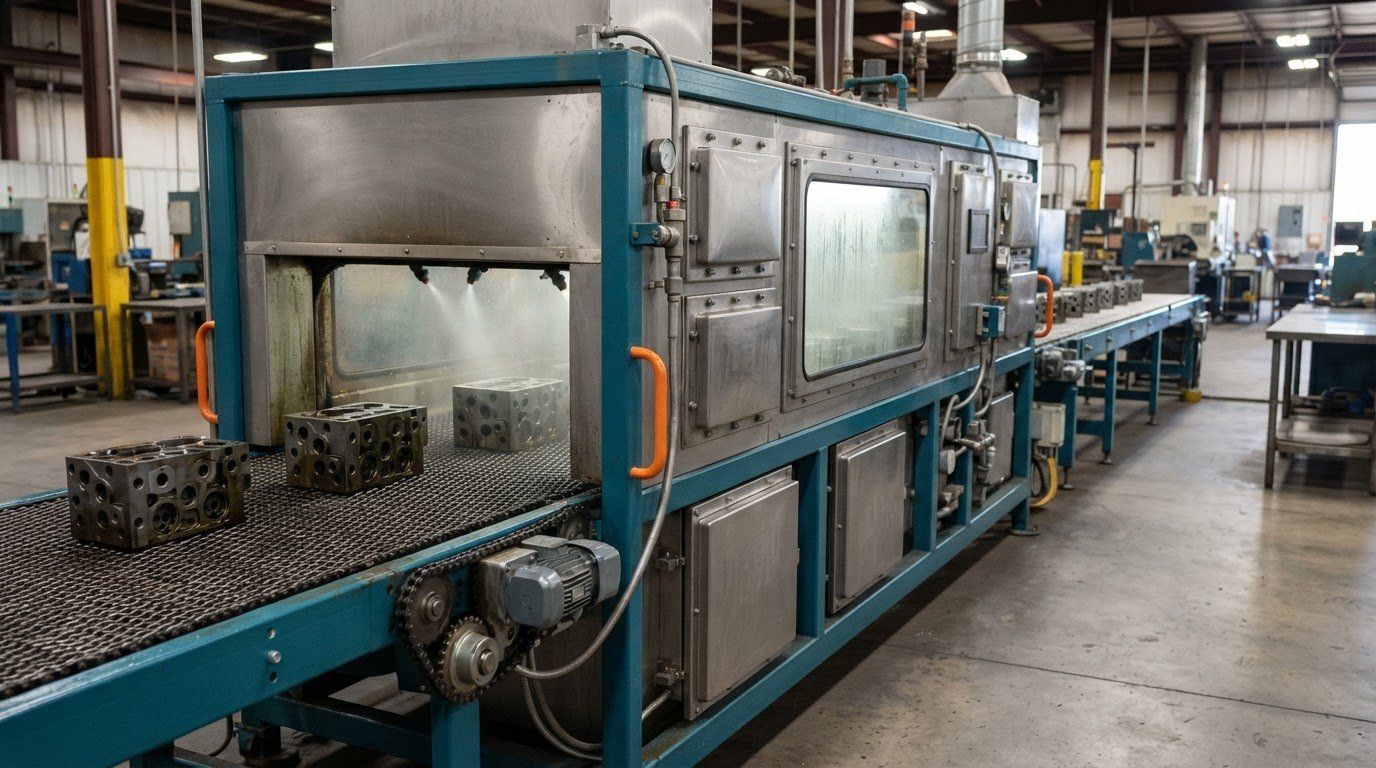
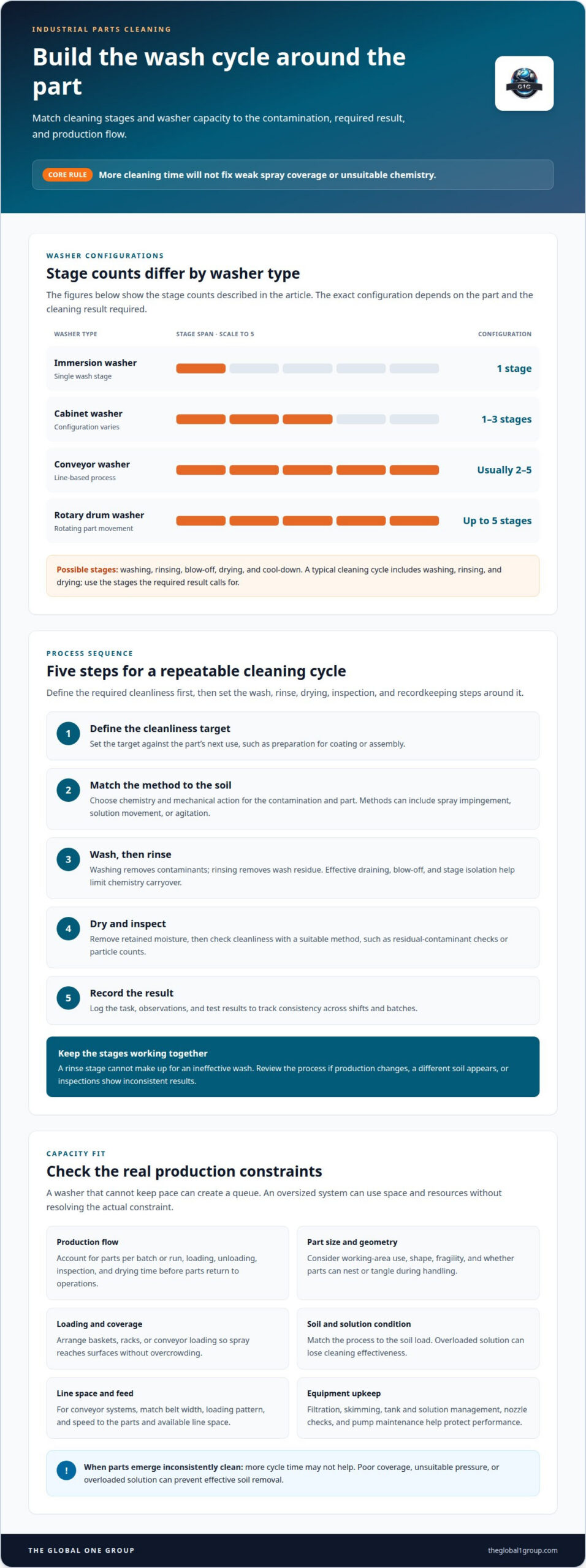
More cleaning time won’t fix a poorly matched wash cycle. The best practices for industrial parts cleaning start with matching the stages to the part, the contamination, and the production requirement. Immersion washers typically use 1 wash stage, cabinet washers can have 1-3 stages, and conveyor washers usually use 2-5 stages for operations such as washing, rinsing, blow-off, drying, and cool-down.
A clean part matters, but the cleaning process must also fit the production line without creating a bottleneck. Spray coverage, chemistry, and stage sequencing affect results, while washer capacity and automation determine how consistently cleaning supports production. This guide explains how to choose cleaning stages, match washer capacity to workload, and select chemistry for the soil and part material. It also covers integrating automated cleaning into production while supporting consistent part quality, safe handling, and dependable throughput.
Key Takeaways
- Build cleaning schedules around production demands, equipment needs, and the contamination each task must remove.
- Match washer capacity to workload and monitor solution condition to keep cleaning performance consistent.
- Set cleanliness requirements around the part’s application, then use suitable checks to assess the result.
- Choose chemistry based on the soil and part material, and manage concentration, temperature, and rinse carryover.
- Use automation and production-line integration to coordinate cleaning cycles with throughput requirements.
1. What Are the Stages of Industrial Parts Cleaning and Sanitation?
Build a cleaning schedule around production hours, equipment, contamination, and applicable regulations. A parts-cleaning cycle typically includes washing, rinsing, and drying, with the required result determining which stages to use. The best practices for industrial parts cleaning begin with defining what “clean” means for the part’s next operation, then matching the process to that requirement.
Use written protocols to make the requirements repeatable. Specify which equipment and parts need cleaning, the method, the inspection step, and how workers record completion. A useful log records who performed each task, when it happened, and what the work involved. Keep checklists practical: operators should be able to identify the machine, follow the sequence, and record observations without disrupting production.
Separate routine housekeeping from equipment care and deep cleaning when setting schedules. Daily tasks might include cleaning high-traffic areas and addressing spills. Weekly plans might cover dusting and machinery cleaning, while monthly plans might include deep cleaning and preventive maintenance cleaning. Adjust timing to operating hours, production schedules, equipment demands, and contamination risks rather than applying the same calendar to every environment.
For United States requirements, OSHA sets workplace cleanliness standards for facilities. According to the U.S. Environmental Protection Agency, HEPA filters are designed to remove at least 99.97% of airborne particles that are 0.3 micrometers in diameter or larger; that figure concerns air filtration, not a parts-washer cycle.
Use this sequence to structure a parts-cleaning process:
- Define the cleanliness target. Set it against the part’s actual application, such as preparation for coating or assembly.
- Match the wash method to the soil. Choose chemistry and mechanical action based on the contamination and part, using spray impingement, solution movement, or agitation where appropriate.
- Wash, then rinse. Cleaning removes contaminants; rinsing removes wash residue. Effective draining, blow-off, and stage isolation help limit chemistry carryover.
- Dry and inspect. Remove retained moisture, then assess cleanliness using a suitable method, such as residual-contaminant checks or particle counts.
- Record the result. Log the task, observations, and test results so teams can track consistency across shifts and batches.
A rinse stage cannot make up for an ineffective wash. Nor will a longer cycle fix weak spray coverage or unsuitable chemistry. Review the checklist when production changes, a different soil appears, or inspections reveal inconsistent results. This keeps schedules aligned with operations and gives crews a clear response when cleaning performance shifts.
OSHA sets workplace cleanliness standards for facilities. The cited EPA information concerns HEPA air filtration, not requirements for a parts-washer cycle.
2. Matching washer capacity to production volume
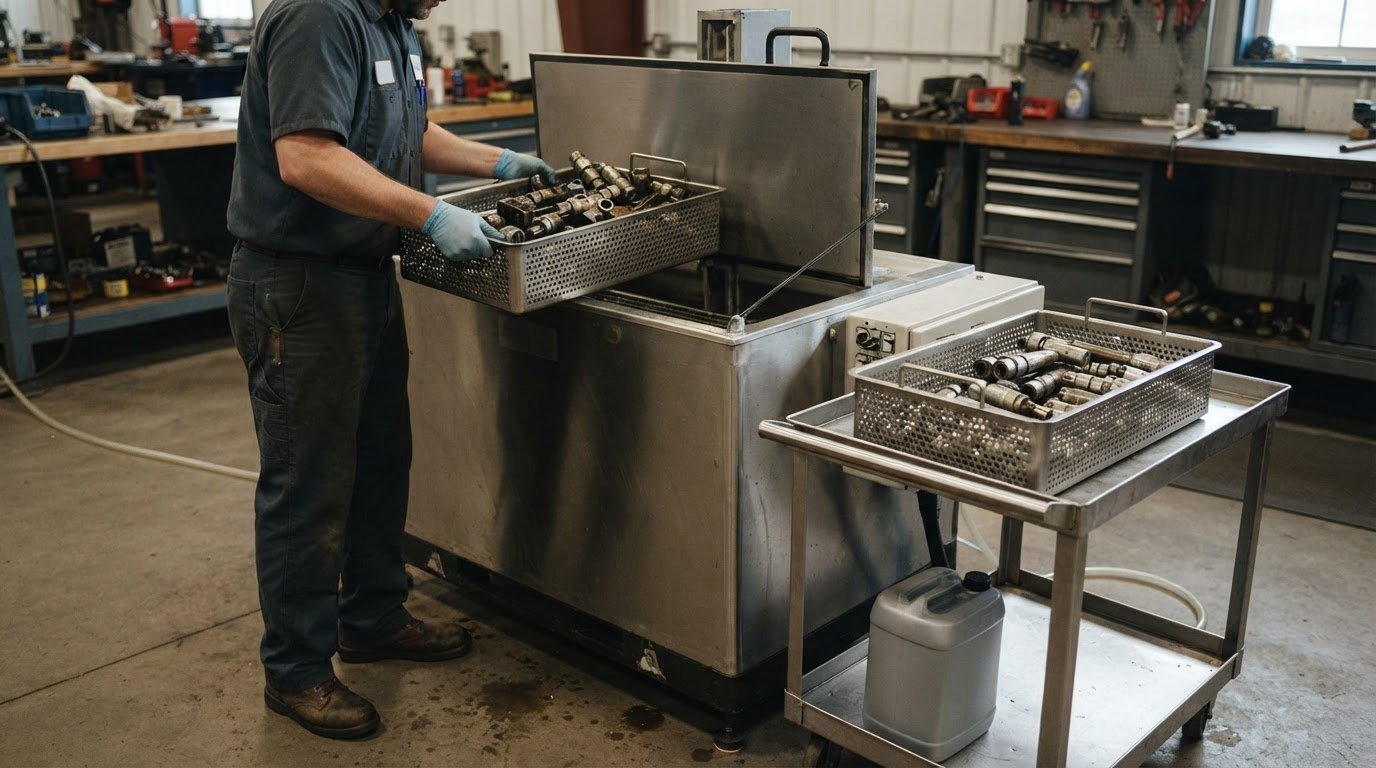
A washer that cannot keep pace creates a queue, while an oversized system can consume space and resources without addressing the actual constraint. Match capacity to production flow, part mix, soil load, and available cleaning time. Start with the number of parts in each batch or production run, then account for loading, unloading, and any inspection or drying time before parts return to operations.
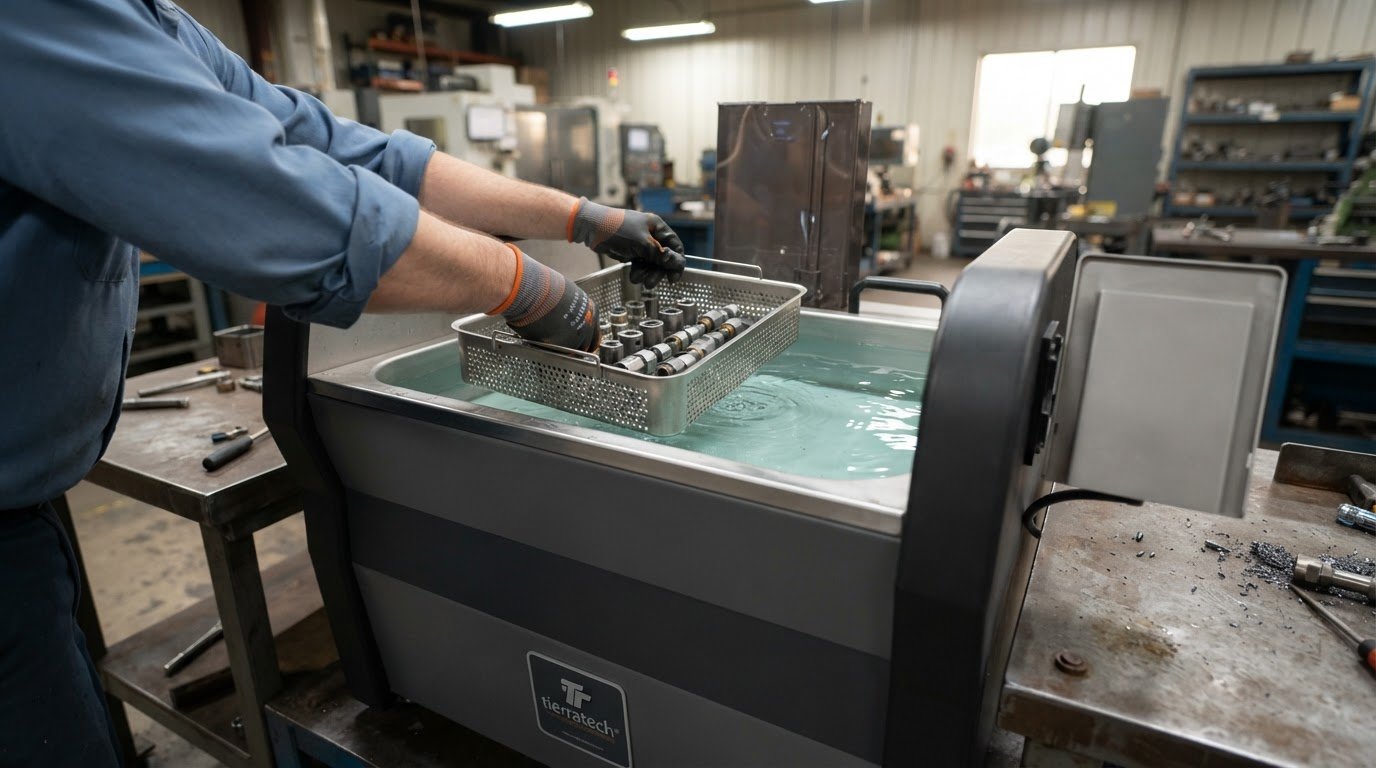
Part size and geometry matter as much as volume. A large component may take up most of a cabinet’s working area, while smaller parts can be cleaned together only if spray reaches their surfaces. Choose a basket or rack arrangement that exposes parts to the cleaning action without overcrowding. If parts emerge inconsistently clean, adding cycle time may not help. Poor coverage, unsuitable pressure, or overloaded solution can prevent a washer from removing soil effectively.
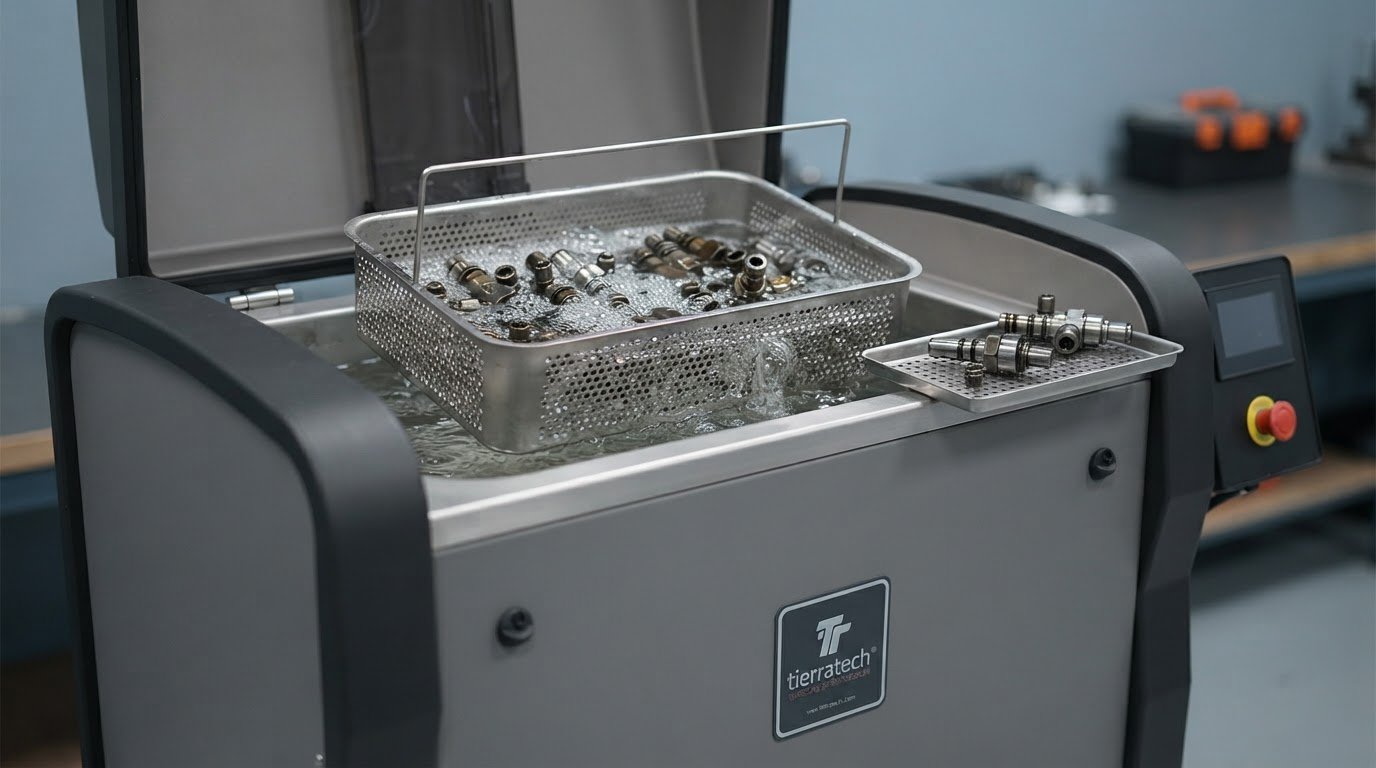
Rotary basket washers suit parts handled in batches, with rotation helping expose different surfaces during the cycle. Rotary drum washers move parts through a rotating process and can have up to 5 stages for washing, rinsing, blow-off, drying, and cool-down. Consider part size, shape, fragility, and the risk of parts nesting or tangling before selecting either method. The proper configuration depends on how the parts move through production and what result the next operation requires.
Conveyor and tunnel washers fit production lines that need parts to move through a defined process rather than wait for separate batch cycles. Conveyor washers are usually configured with 2-5 stages, which can include washing, rinsing, blow-off, drying, and cool-down. Match belt width, loading pattern, and conveyor speed to the parts and available line space. A steady feed only helps if the wash process can handle the incoming work without creating a downstream pileup.
Custom configuration should address the real production constraint, not just a target cycle rate. Map the part path, load pattern, soil type, and required cleanliness result. Then determine whether batch handling, a rotary system, or a conveyor layout best fits operations. Industrial parts washers can be considered in that capacity assessment alongside part-washing chemistry.
Protect usable capacity with regular maintenance. Filtration, skimming, tank maintenance, and scheduled solution management help control soil buildup, since overloaded solution can lose cleaning effectiveness. Inspect nozzles for clogs and check pumps, strainers, and leaks during preventive maintenance. A blocked nozzle can reduce coverage, while pump wear can undermine wash performance. Track recurring issues against cleaning results and the production schedule, then address the source before it disrupts throughput.
3. Why parts cleaning supports quality, safety, and production
Clean parts protect manufacturing quality because residue can interfere with coating, bonding, assembly, or inspection. A swab test can detect residual contaminants on production parts, while adhesion results can show whether surface preparation supports the next process. Choose a check that matches the part’s application, then use the same method across shifts and batches. Consistent results help teams spot process drift before it affects downstream operations.
Rinsing and drying affect part condition and shop-floor safety. Residual detergent can leave deposits, while retained moisture can contribute to corrosion or disrupt the next manufacturing step. Blowers, air knives, or heat can remove liquid or evaporate water. Excess water can also prolong drying, delay production, create slip hazards, and add cleanup work. After drying, inspect parts for visible spotting, retained moisture, and residue.
Routine inspection helps cleaning equipment sustain performance. Check washer nozzles for clogs and brushes for wear, as either can reduce cleaning action. Preventive maintenance should also address pump wear, clogged strainers, and leaks. A maintenance record linked to each production run helps teams identify recurring failures and schedule corrective work before equipment problems affect output.
Keep process records precise. Document the cleaning agents used, temperature and pressure settings, cycle duration, observations, and test results. These details help operators compare batches and investigate changes in part quality. For example, if a swab test detects residue, the record can show whether the cleaning agent, settings, or cycle duration changed. Use the findings to guide a controlled adjustment, then record the follow-up result.
Cleaning chemicals and equipment can expose workers to chemical contact, hot solutions, pressurized spray, and wet-floor hazards. Match PPE to the application, including safety glasses, gloves, protective footwear, and clothing. Use hearing or respiratory protection when needed. Train workers in chemical handling, equipment operation, hazard communication, lockout/tagout, and waste disposal.
Training should cover the cleaning agents and machine controls actually used on the floor, not just general procedures. Workers need to understand temperature and pressure settings, safe handling, and disposal practices. Industrial cleaning contractors should ensure workers have the licenses or training certifications required for the job site. Keep training records with equipment and process logs so supervisors can connect operator readiness with cleaning results.
Use housekeeping methods suited to each work area. In a warehouse, routine vacuuming can remove dust from surfaces where it accumulates, while prompt spill response reduces slip exposure around equipment and walkways. Choose specialized cleaning methods to suit the soil and surface, and use the right agents for the task. Clear records, trained operators, and maintained equipment make cleaning a controlled part of production rather than an unpredictable interruption.
4. Aqueous versus solvent-based cleaning chemistry
Choose chemistry by matching the part material, geometry, and soil to the cleaning action. Aqueous washing uses water with detergents, surfactants, and builders, applied through spraying, immersion, or both. Consider whether the solution reaches recesses and whether the part substrate tolerates the selected chemistry. A conveyor process also needs chemistry suited to its wash and rinse stages.
There is no universal winner between aqueous and solvent-based cleaning. Compare each process against contaminant type, part compatibility, cleanliness requirements, equipment configuration, and waste handling. Ultrasonic systems use cavitation in the cleaning solution. Evaluate vapor degreasing separately, considering the process, chemistry, and facility controls. These factors help identify the method that fits the part and production environment.
Cleaning temperature and concentration affect performance and efficiency. In aqueous cleaning, heat can reduce soil viscosity, loosen deposits, and accelerate chemical action. Excessive or insufficient temperature can reduce efficiency or damage parts. Too little chemical may leave contamination; too much may increase cost, foam, or leave residue. Standardize concentration checks and track settings so operators can identify process changes.
Compare water, chemical, energy, labor, and waste-management demands when assessing operating costs and environmental impacts. Aqueous systems use water and cleaning agents, while energy and labor needs depend on the equipment, cycle, and production setup. For aqueous, solvent, ultrasonic, and vapor degreasing processes, assess chemical hazards, resource use, and resulting waste streams. Do not rank a method on purchase or operating cost alone.
Maintain solutions through filtration, skimming, tank maintenance, and scheduled solution management. These steps help control accumulated soil and preserve cleaning effectiveness. Reuse a solution only while its condition supports the required cleaning result, and remove it from service when soil loading undermines performance. Plan disposal through the facility’s waste-management procedures, including applicable chemical and wastewater streams.
Keep chemical controls visible on the workplace floor. Label containers clearly, store them according to their hazards, and make Safety Data Sheets available to employees. These sheets describe chemical hazards, safe handling, storage, first aid, and spill response. Train operators in relevant handling and disposal procedures before they service a tank or replenish a washer.
Prevent carryover between wash and rinse stages. Effective draining, blow-off, and stage isolation limit wash chemistry entering the rinse, where residue can reduce rinse quality and increase operating costs. For example, if detergent residue remains after rinsing, review solution concentration, drainage, and stage separation before extending the cycle. Record the adjustment and its cleaning result to support repeatable process control.
Costs and environmental impacts depend on each system’s equipment, cycle, and production setup. Compare water, chemicals, energy, labor, and waste-management demands. Aqueous systems use water and cleaning agents. For aqueous, solvent, ultrasonic, and vapor degreasing, assess chemical hazards, resource use, and resulting waste streams rather than ranking methods on purchase or operating cost alone.
5. Automation and production-line integration
Automation should fit the production sequence, not force the line to work around the washer. Map where parts enter, how operators load them, and where cleaned components go next. For an automotive plant processing thousands of components per hour, cleaning must keep pace with upstream output and avoid a queue before assembly. The practical goal is a stable handoff between operations.
A programmable logic controller (PLC) can manage cycle timing, temperature, and stage sequencing in an industrial parts washer. This coordination helps keep the programmed process consistent across production runs. For example, a PLC can control the sequence from washing through rinsing and drying, while operators follow defined loading and unloading procedures. Clear settings also make changes in cleaning results easier to investigate.
Conveyor washers integrate cleaning into continuous material flow. Parts travel through the machine instead of waiting for a separate batch cycle, which can suit lines with repeatable part movement. Set conveyor speed in relation to the cleaning time required for the soil and component. If parts arrive faster than the washer can process them, residue or inconsistent results can interrupt downstream work.
Plan part handling at the washer entrance and exit. Fixtures and loading patterns should keep components stable and expose surfaces that need cleaning. Closely packed parts can shield contact areas from spray, while poor orientation can complicate unloading. Set a defined route for clean parts so they do not cross paths with incoming, contaminated components. This separation helps protect finished surfaces during transfer.
Production integration also requires a clear response when the process stops. Define who manages the washer, what happens to parts already inside, and how the line resumes after a pause. Record cleaning settings and inspection results by production run. If an operator finds residue, the team can review the cycle conditions and determine whether the issue began at the washer or earlier in handling.
Choose automation for the production need: repeatable cycle control, a conveyor handoff, or coordinated movement between cleaning and the next operation. Include operator access, loading ergonomics, and maintenance tasks in the integration plan. A system that fits the physical layout but disrupts part flow will not support steady output. Align equipment, cycle sequence, and material handling before settling on a line configuration.
To connect washer selection with line demands, discuss production-line washer requirements.
The Global One Group: Industrial Parts Washers
The Global One Group offers Industrial Parts Washers, parts washing chemistries, and parts for Magido and Fountain. These products serve production needs for a washer, cleaning chemistry, or replacement parts for those brands. Match requirements to the part type, contamination, cleaning stages, and production flow described above. This gives your team a practical starting point for considering washer capacity and process chemistry together, rather than treating them as separate decisions.
For industrial parts washer, parts washing, chemistry, or Magido and Fountain parts inquiries, contact The Global One Group.
Turn Your Cleaning Requirements Into a Practical Next Step
Start the next improvement with a production constraint you can address: inconsistent results, avoidable handling, or a washer that no longer fits the line. Choose a representative part and trace its route through cleaning and downstream use. Applying the best practices for industrial parts cleaning means grounding the next process decision in actual production needs, not assumptions. Note where the current workflow causes delays or requires extra operator attention.
Bring part requirements, contamination concerns, and production flow into the equipment conversation. A focused discussion can clarify which washer and chemistry considerations deserve priority and where a change may affect operators or line integration. Keep the goal straightforward: a cleaning process your team can operate consistently and maintain as production evolves.
Take the next step when you’re ready to assess your cleaning requirements. Contact The Global One Group to discuss the right direction for your operation. Start with the parts and process challenges that matter most, then move forward with a clearer plan.
Frequently Asked Questions
What Are the Stages of Industrial Parts Cleaning and Sanitation?
A typical parts-cleaning sequence includes washing, rinsing, and drying, with additional stages chosen for the part and required finish. A cabinet washer may combine washing with blow-off, while a multistage system can add separate rinses, drying, or cool-down. Sanitation needs depend on the facility and application. Define the required outcome first, then select stages that address the contamination without adding unnecessary steps.
What Drying Methods Are Used?
Industrial parts commonly dry with a blower, air knives, or heat. Air knives direct airflow across part surfaces to clear liquid, while heated air can evaporate remaining water. Choose a method based on part geometry, retained moisture, and the next production step. Recesses and overlapping surfaces may hold liquid after blow-off, so inspect representative parts to determine whether the drying method removes moisture adequately.
What Happens During the Wash Phase?
The wash phase combines cleaning chemistry with mechanical action to loosen and remove soil. Spray impingement, solution movement, agitation, or targeted nozzle coverage delivers that action to contaminated surfaces. For example, grease trapped in a recess may need better spray access, not a longer cycle. Operators can inspect the part after washing to identify missed areas and adjust coverage or chemistry.
What are the main industrial parts cleaning methods and how do they compare?
Common methods include spray cabinet, immersion, rotary drum, conveyor, and ultrasonic cleaning. Cabinet washers handle parts in a contained chamber; conveyor systems move parts through sequential stages; rotary drums process parts along a rotating path. Ultrasonic washers use cavitation bubbles in solution to reach intricate surfaces. Compare part geometry, fragility, soil, and production flow to determine which method provides suitable contact and handling.
What cleaning agents and detergents are commonly used for industrial parts cleaning?
Aqueous cleaning commonly uses water with detergents, surfactants, and builders. The right chemical depends on the contaminant, part material, concentration, and required cleanliness. Match the agent to the soil and material, then check for residue after rinsing. Household soaps primarily remove dirt, oils, and other contaminants; they are not designed primarily to kill or inhibit microorganisms. Use antimicrobial agents when that function is required.
What cleaning temperature, concentration, pressure, and cycle time ranges are recommended?
There is no single suitable range for every part or washer. Set temperature, concentration, pressure, and cycle time according to the contaminant, substrate, spray coverage, and required cleanliness. In aqueous cleaning, heat can loosen soil and accelerate chemical action, but unsuitable temperatures can reduce efficiency or damage parts. Establish settings using production parts, document them, and adjust one process variable at a time when results change.
How do you validate industrial parts cleanliness and set acceptable residue limits?
Validate cleanliness against the part’s actual application, then use a test suited to the residue or surface requirement. Options include swab testing, particle counts, residual-contaminant levels, water-break-free testing, and gravimetric analysis. Set acceptance limits based on downstream needs, such as coating adhesion or assembly performance, rather than relying on an undefined “clean” standard. Record test results alongside process settings to compare batches and investigate failures.
How can manufacturers prevent corrosion, flash rust, and recontamination after cleaning?
Remove retained moisture promptly, limit contact with contaminated surfaces, and use rinse chemistry suited to corrosion protection when the process requires it. A rinse containing rust inhibitor can support protection after washing. Keep clean parts separate from incoming soiled components during unloading and transfer. Inspect parts for water spots or early corrosion before the next operation, and review drying and handling steps if defects appear.