A part that comes out dirty does not always point to a washer problem. The soil, part material, cleaning chemistry, and process settings all affect the result. Industrial aqueous cleaning systems can handle demanding applications, but reliable cleaning starts by matching the process to the parts and production requirements, not by choosing equipment first.
If you’re unsure whether water-based cleaning will remove your oils, coolants, or other process soils, start by examining the part, its contaminants, and the cleanliness required for the next operation. This guide explains how to assess those factors and create a practical plan to test and validate a cleaning process.
You’ll learn which process controls affect cleaning performance, how to check for residue or material concerns, and what to record during trials. We’ll also cover the production and application details to prepare before discussing equipment and chemistry with a supplier, so decisions are based on part-level results and shop-floor needs.
Key Takeaways
- Define the cleaning target by documenting required cleanliness, part geometry, production volume, and downstream needs.
- Select cleaning, rinsing, drying, and verification stages for the application rather than assuming every process needs the same setup.
- Match industrial aqueous cleaning systems and process controls to part size, soil load, cycle frequency, and available floor space.
- Test representative parts under realistic soil conditions, inspect the results, and document approval before stabilizing the process.
- Prepare details about parts, soils, throughput, acceptance criteria, and site constraints before discussing equipment and chemistry.
Industrial aqueous cleaning systems: define the cleaning problem first
Start with the part and its next operation, not a washer catalog. Industrial aqueous cleaning systems bring cleaning equipment, water-based chemistry, process controls, and part handling together. Chemistry alone is not a complete system: equipment delivers the cleaning action, controls manage operating conditions, and part handling moves components through the process. For context on different approaches, see this overview of industrial parts cleaning methods.
Before selecting equipment or chemistry, define the target in operational terms. Record the required cleanliness, production volume, part geometry, and next manufacturing, inspection, or assembly step. A part can look clean and still carry residue that interferes with a coating, seal, or assembly. Visible soil removal, residue limits, corrosion protection, and particle cleanliness are distinct requirements. Ask the process owner to define “clean enough” and how the team will verify it.
Which parts and soils will the aqueous process handle?
Build a representative profile of the parts and soils. Include material, dimensions, blind holes or passages, tight clearances, and sensitive surfaces or finishes. Identify contaminants such as oil, grease, particulates, or machining fluids, and note whether they vary between production runs. Record how long soils remain on parts and how heavily they build up. Aged or heavier deposits may behave differently during cleaning, so include them in process trials.
What does clean enough mean for the next operation?
Set acceptance criteria with quality and production before testing. A part headed for assembly may need a different cleanliness check from one moving to another process. Confirm whether parts must leave the wash dry, protected against corrosion, or free of a defined residue. Document the inspection method and pass-fail criteria so trial results can be assessed consistently.
Make the criteria practical to verify. Specify where inspectors should look, what evidence counts as a pass, and how the team will handle a borderline result. If particle contamination matters, define an appropriate inspection or cleanliness method with the responsible quality team rather than relying on appearance alone. This avoids approving a washer based on a clean-looking sample that fails the actual production requirement.
Capture the agreed targets before comparing process options. This gives equipment and chemistry discussions a concrete basis: the parts, soils, output rate, and acceptance standard must work together. Without a defined target, teams may focus on visible soil removal while missing the requirement that controls downstream quality.
How an aqueous cleaning system moves soil through each process stage
A cleaning cycle is a sequence, not just a wash step. Parts may move through loading, cleaning, rinsing, drying, and verification, depending on the application. An oily component headed for assembly may need different handling from a part with blind passages or a surface that must be dry before the next operation.
Industrial aqueous cleaning systems bring equipment, water-based chemistry, process controls, and part handling together. Temperature, chemistry concentration, contact time, and mechanical action all influence results. Changing one variable can affect how well the process removes soil, so establish suitable settings through trials and check them against equipment and chemistry documentation. Don’t assume one cycle or configuration will suit every part.
How do chemistry and mechanical action support cleaning?
Water-based cleaning chemistry helps loosen or disperse soils, while mechanical action helps bring the solution into contact with part surfaces. Depending on the equipment and application, that action may use spray, immersion, or another method. Part orientation matters: a poorly positioned component can shield surfaces or trap soil and solution.
Keep the process variables coordinated. A change in soil loading or contact time can affect results even when washer settings stay the same. For chemistry-specific guidance, consult the chemistry supplier and review the equipment and chemistry documentation before changing settings or chemistry.
When do rinsing and drying belong in the process?
A rinse may help remove remaining soil or cleaning solution, but it is not automatically necessary for every application. Decide based on the chemistry, the part’s cleanliness requirements, and what happens next. Drying also depends on the job: retained moisture may affect handling, storage, or a downstream operation. Confirm the sequence with equipment and chemistry documentation, then check the result during trials.
Use this sequence as a planning framework, not a universal recipe:
- Load: Position parts so the process can reach the surfaces that need cleaning.
- Clean: Apply the selected chemistry and mechanical action under controlled conditions.
- Rinse, if required: Remove remaining soil or solution according to process needs.
- Dry, if required: Meet the handling or downstream moisture requirement.
- Verify: Inspect against the agreed acceptance criteria.
Align the process stages with your parts and production goals before selecting equipment. To compare washer and chemistry options, discuss industrial parts washers and cleaning chemistry with The Global One Group.
Match aqueous cleaning equipment and process controls to the application
Choose equipment around the work your wash area needs to handle. Consider part dimensions and geometry, loading method, cycle frequency, soil loading, operator access, and available floor space. Industrial aqueous cleaning systems should support the actual workflow, not require operators to rearrange parts or interrupt production to accommodate the machine.
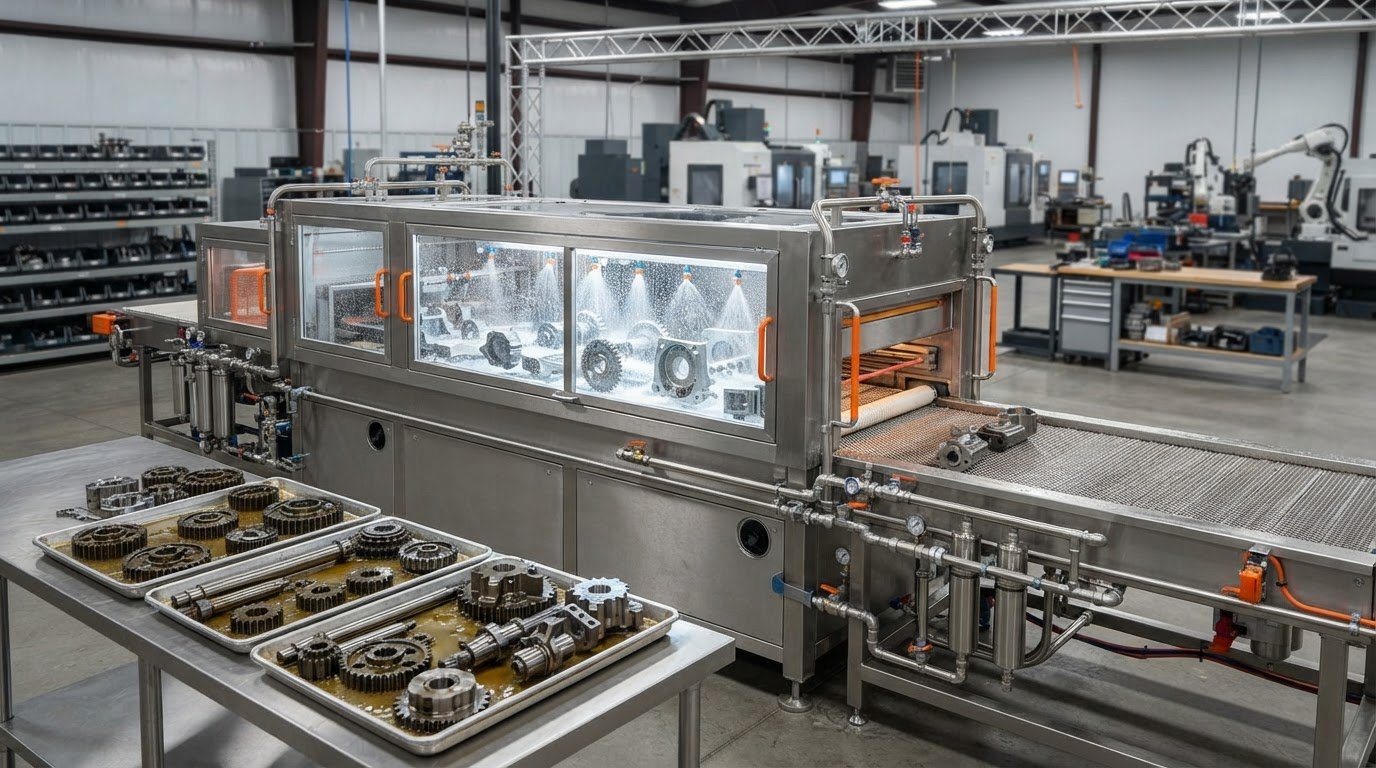
Batch workflows can suit jobs where parts are grouped for cleaning in defined cycles. Production-flow arrangements may suit operations that need repeated cycles or a steady movement of parts through the wash area. Neither approach is automatically better. Compare the practical trade-offs against your parts and schedule:
| Consideration | Batch workflow | Production-flow workflow |
|---|---|---|
| Process fit | Evaluate whether grouped loads match the work mix and cycle planning. | Assess whether a more continuous sequence suits recurring production needs. |
| Loading | Check that each load fits the chamber and can be arranged consistently. | Consider how parts enter, move through, and exit the process. |
| Access | Allow space for loading, unloading, and operator movement. | Plan access along the part-handling route and around the wash area. |
| Controls | Define checks for each cycle and its load conditions. | Determine how operators will monitor the process across repeated cycles. |
| Maintenance | Confirm access for routine inspection and equipment upkeep. | Check maintenance access without disrupting surrounding work areas. |
Which equipment configuration fits the parts and workflow?
Start with the largest or most awkward parts, then consider how operators will load them without blocking surfaces that need cleaning. Account for blind features, load arrangement, handling equipment, and aisle clearance. Compare expected cycle frequency with production schedules, and ask suppliers for application-specific capacity and performance information. Rather than relying on generic throughput claims, request details that reflect your part mix and process conditions.
Which process controls should operators monitor?
Identify the controls that matter for the selected equipment and chemistry. These may include temperature, cycle time, and solution condition. Set operating limits using manufacturer guidance and validated application trials. Then assign responsibility: document who checks each control, how often it is checked, where results are recorded, and what action to take when a reading falls outside the approved range.
Keep the control plan usable on the floor. A clear log and defined response help operators spot process drift before it leads to inconsistent cleaning or avoidable rework. Confirm that equipment, chemistry, and maintenance requirements work together for the application, and ask suppliers to explain the basis for capability claims.

How to test, commission, and stabilize an aqueous cleaning process
A washer is ready for production only after the process meets agreed acceptance criteria under realistic conditions. Clean demonstration samples won’t show how soil age, load arrangement, or normal production variation affects results. Trial representative parts before production rollout to check whether the process can meet real cleaning requirements with actual parts, soils, and loading conditions.
Use a repeatable trial sequence. Select representative parts and soils, recreate the normal loading pattern, and confirm the cleanliness required for the next operation. Record the setup before each trial, including equipment configuration, chemistry, relevant settings, and load details. Inspect the parts using the agreed acceptance method, then document whether they pass and note any residue, moisture, or other concern.
How should a cleaning trial establish acceptance?
Run trials under the conditions expected in production and assess whether results are consistent. If results vary, check loading and record process conditions before making changes. Where practical, adjust one variable at a time, such as cycle time or temperature, to connect each change with its outcome. Use equipment and chemistry guidance to set operating limits, and involve quality and production in reviewing results and approving the process.
Keep a trial record that captures:
- Part and soil: Sample identity, material, soil type, and condition.
- Load: Part quantity and arrangement for each run.
- Process: Chemistry and relevant operating settings.
- Result: Inspection method, findings, and acceptance decision.
- Changes: What changed between runs and why.
This record helps distinguish possible equipment, chemistry, and loading issues instead of treating every failed inspection as the same problem.
How can operators keep the process consistent after commissioning?
Turn approved settings into a floor-ready operating log. Assign who checks each relevant control, when it is recorded, and what action to take if a reading or cleaning result falls outside the approved range. Train operators to notice changes in part appearance or inspection results and to escalate deviations rather than making undocumented adjustments.
Review maintenance and chemistry guidance before changing an established process. If you’re evaluating a washer or parts-washing chemistry, discuss your cleaning process requirements with The Global One Group.
Keep an industrial aqueous cleaning system reliable with the right support
Reliable cleaning depends on more than the washer. Equipment, cleaning chemistry, replacement components, and operator procedures all affect whether a process continues to meet its approved requirements. Treat them as parts of one operating system: a chemistry change may affect results, worn or unsuitable components may alter operation, and inconsistent loading can undermine an otherwise sound setup.
Before speaking with a supplier, prepare a concise application brief. Include:
- Parts: Materials, dimensions, sensitive surfaces, and representative samples or part details.
- Soils: Contaminant types, how long they remain on parts, and how heavily they build up.
- Current process: Cleaning stages, equipment in use, load patterns, and known equipment constraints.
- Production needs: Cleaning frequency, expected volume, and available space around the wash area.
- Acceptance criteria: The cleanliness required for the next operation and the inspection method used to confirm it.
- Current problems: What operators see, how often the issue occurs, and what evidence identifies it, such as visible residue or inconsistent inspection results.
Specific information keeps the discussion focused on your application rather than generic equipment comparisons. If you have an existing washer, record its make and model so the supplier can check documentation before discussing replacement parts or compatibility.
What should you prepare before speaking with a supplier?
Bring the details that connect cleaning performance to daily production: representative parts and soils, current process steps, loading patterns, and the required result. Note where the process creates friction, such as parts emerging with residue or loads that are difficult to position consistently. Share site constraints and acceptance criteria upfront so the supplier can assess equipment and chemistry against a defined need.
How do equipment, chemistry, and replacement parts support uptime?
Equipment and chemistry must suit the soil, part, and process conditions together. Maintenance components matter too, but don’t assume a part fits because it looks similar. The Global One Group supplies industrial parts washers, specialized parts-washing chemistries, and replacement parts for Magido and Fountain equipment. Confirm specific part compatibility against equipment documentation before ordering, and follow manufacturer guidance when maintaining or adjusting the system.
A useful supplier discussion starts with clear process facts, not a request for a machine in isolation. Bring your part and soil details, throughput needs, acceptance criteria, and site constraints to discuss your cleaning application with The Global One Group.
Build a cleaning process you can trust
Reliable industrial aqueous cleaning systems start with a defined result, then align the parts, soils, chemistry, equipment, and production workflow around that target. Set clear acceptance criteria, choose process stages for the application, and test representative parts under realistic conditions before production. Document settings and inspection results so operators can maintain consistency and catch changes early.
The Global One Group supplies industrial parts washers and specialized parts-washing chemistries, and is a Certified Master Distributor of Magido Cleaning Systems. The company also supplies replacement parts for Magido and Fountain equipment. Share your parts, soils, throughput needs, acceptance criteria, and site constraints to make your supplier discussion specific and productive.
Discuss your industrial cleaning application with The Global One Group and take the next step toward a process built around your operation.
Frequently Asked Questions
What is an industrial aqueous cleaning system?
An industrial aqueous cleaning system combines a parts washer, water-based cleaning chemistry, process controls, and part handling to remove soils from components. The washer delivers the cleaning action, while chemistry and operating conditions support soil removal. The setup also accounts for how parts enter and leave the process and how operators verify results. Chemistry alone is not a cleaning system, and the right configuration depends on the parts, soils, production needs, and required cleanliness.
How does an aqueous parts cleaning process work?
An aqueous parts cleaning process loads parts into equipment, applies water-based chemistry and mechanical action, then adds rinsing or drying when the application requires it. Operators verify results against established acceptance criteria. Spray or immersion may bring the solution into contact with part surfaces, depending on the equipment and application. Temperature, contact time, chemistry condition, and load arrangement can affect results, so follow equipment and chemistry guidance and validate settings with representative parts.
Can aqueous cleaning remove oil and grease from industrial parts?
Yes, aqueous cleaning can remove oil and grease when the chemistry and process match the soil and part. Results depend on factors such as the type and age of the oil, how heavily it coats the component, part geometry, and cleaning action. Check that the chemistry suits the part material and downstream requirements. Test representative parts under realistic soil and loading conditions, then inspect them using agreed pass-fail criteria before adopting the process.
How do I choose an aqueous cleaning system for my parts?
Choose an aqueous cleaning system by matching equipment and chemistry to your parts, soils, workflow, and cleanliness target. Document part materials, dimensions, blind features, soil types, production frequency, load patterns, available floor space, and the next operation. Decide whether a batch or production-flow approach better suits the work. Ask suppliers for application-specific equipment and chemistry information, then compare proposed capabilities with trial results from your parts and agreed acceptance criteria.
What factors affect aqueous cleaning performance?
Aqueous cleaning performance depends on the interaction of chemistry, temperature, contact time, mechanical action, soil condition, and loading. Tightly arranged parts may prevent the solution from reaching some surfaces, while aged or heavy soil may respond differently from fresh contamination. Part material and geometry also matter. Track settings and inspection results during trials, and use manufacturer guidance to set operating limits rather than relying on assumptions.
Do industrial aqueous cleaning systems always require a rinse and drying stage?
No. Rinsing and drying depend on the chemistry, part requirements, and next operation. A rinse may be needed to remove remaining soil or cleaning solution; drying may matter if retained moisture affects handling, storage, or downstream processing. Some applications may not need one or both stages. Confirm the sequence with equipment and chemistry documentation, then verify the outcome during trials against the agreed cleanliness and moisture requirements.
How can I test whether an aqueous cleaning process meets my requirements?
Test the process with representative parts, realistic soils, and normal loading patterns before production rollout. Define cleanliness criteria and an inspection method with quality and production, then record the chemistry, equipment settings, load arrangement, and trial results. If results vary, repeat the trial and change one process variable at a time where practical. Document approved settings and pass-fail criteria so operators can reproduce the process and identify deviations.